
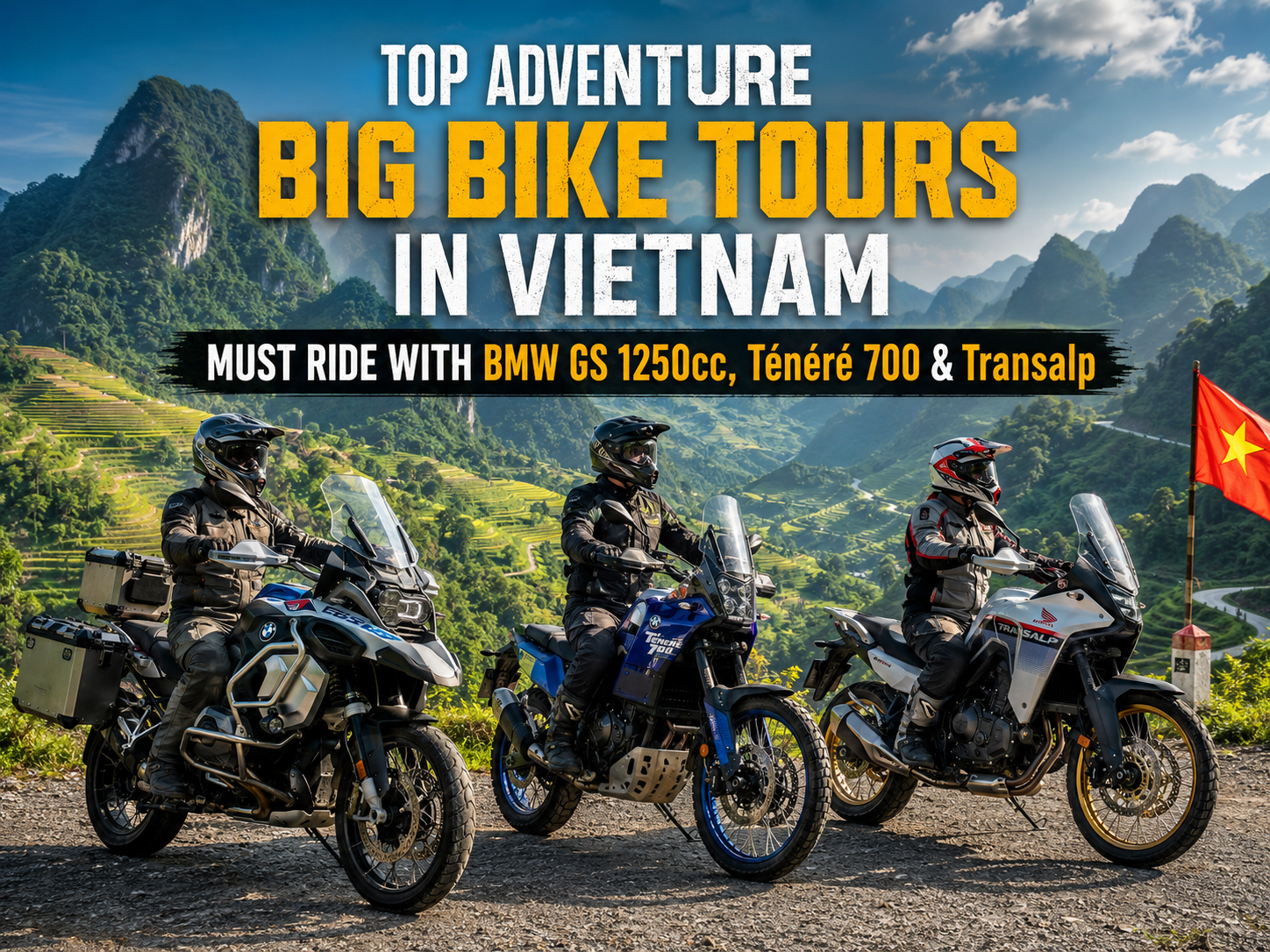
Top Adventure Big Bike Tours in Vietnam Must Ride with BMW GS 1250cc, Ténéré 700 & Transalp
There is a moment on a great motorcycle journey when the destination stops mattering.
You are standing on the pegs, the engine is pulling cleanly beneath you, the road ahead disappears around another limestone ridge, and somewhere far below, a river is cutting a silver line through the valley. A few minutes earlier you were carving through smooth mountain twisties. Now the asphalt has narrowed into a broken backroad where buffalo wander between rice terraces and children wave from wooden houses beside the track.
This is adventure motorcycling in Vietnam.
For riders accustomed to the wide roads of Australia, the Alpine passes of Europe or the long-distance highways of North America, Vietnam offers something remarkably different. Distance is measured less in kilometres than in experiences. Two hundred kilometres can mean six hours of sharp curves, steep passes, village tracks, changing road surfaces, misty mountain ridges, jungle roads and encounters with communities whose rhythms of life have changed surprisingly little over generations.
Vietnam’s official tourism authority describes Hà Giang as a destination best experienced on two wheels and highlights the region’s dramatic roads, remote towns and minority villages. Its famous loop runs through Quản Bạ, Yên Minh, Đồng Văn and Mèo Vạc across high passes and deep valleys.
But Hà Giang is only the beginning.
Ride farther and Vietnam unfolds into a country seemingly designed for the modern adventure motorcycle: BMW R 1250 GS, Yamaha Ténéré 700, Honda XL750 Transalp, Africa Twin, Triumph Tiger, KTM Adventure and similar ADV machines.
From the karst frontier of Northeast Vietnam to the rice mountains of the Northwest, from the historic Ho Chi Minh Road to the jungles surrounding Phong Nha and the former battlefields around Khe Sanh, the country offers an extraordinary collection of Best ADV Motorcycle Routes Vietnam riders can string together into anything from a six-day escape to an epic three-week expedition.
This guide explores the routes we believe make the most sense for experienced international riders looking for a genuine Adventure Big Bike Tour in Vietnam — while also explaining which motorcycle works best, what the roads are actually like and what you should know before committing to the ride.
Why Vietnam Is Made for Adventure Big Bike Tours
Vietnam is long, narrow and extraordinarily mountainous.
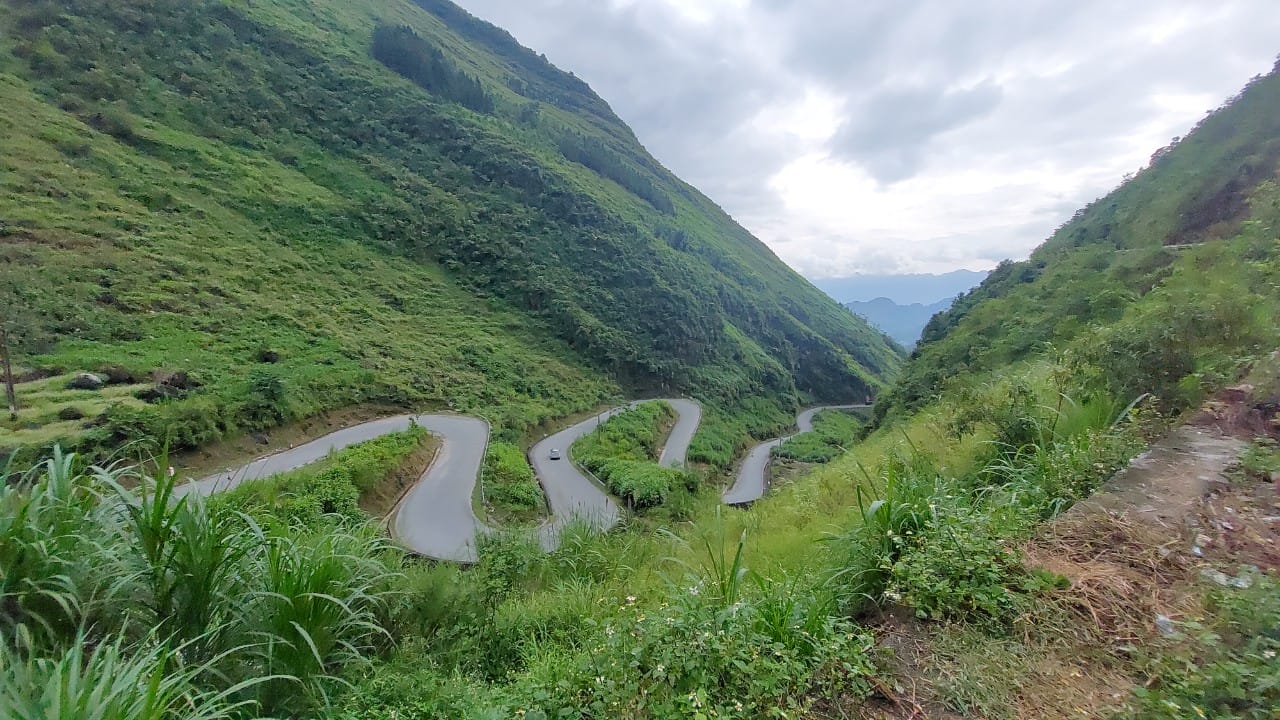
That geography gives ADV riders something difficult to find in many established motorcycle destinations: constant variation.
A morning may start on cool mountain tarmac above the clouds, continue through a rough construction section, dive into a valley on tight hairpins, cross a small town full of scooters and finish beside a quiet lake in a Tay or Dao village.
Vietnam Tourism calls the Hà Giang Loop one of Asia’s outstanding road trips and specifically notes its high passes, deep abysses and seemingly endless curves. Farther south, its official guide to the Hoi An–Hue journey describes the ride over Hai Van Pass as one of Southeast Asia’s spectacular coastal journeys.
For an adventure rider, the attraction is not outright speed.
It is rhythm.
You accelerate out of one bend only to brake for another. You learn to read the road surface. You watch for gravel washed across a corner, a truck emerging from a blind bend, livestock walking home or mist suddenly swallowing the ridgeline.
That is why a Vietnam motorcycle journey rewards riders who enjoy technical touring rather than high-speed touring.
What makes an ADV ride in Vietnam different?
Expect a constantly changing mixture of:
- sweeping mountain asphalt;
- tight switchbacks and sharp curves;
- narrow concrete village lanes;
- damaged or patched provincial roads;
- gravel connections;
- forest roads;
- dirt tracks;
- occasional rocky sections;
- steep climbs and descents;
- wet clay and muddy roads after rain;
- remote backroads and wild tracks;
- optional single trails for suitably skilled riders on appropriate bikes.
The key word is optional.
A professionally designed big-bike itinerary should never force a fully loaded BMW GS into deep mud or technical single-track simply because a marketing brochure promises “extreme off-road.”
A good guide reads the riders, motorcycles, weather and road conditions and adjusts the route accordingly.
Sometimes the most experienced decision of the day is not taking the hardest track.
BMW GS 1250 vs Ténéré 700 vs Honda Transalp: Which Bike Works Best in Vietnam?
Choosing the right motorcycle matters more in Vietnam than many riders initially expect.
A 1,250cc adventure bike can be magnificent on sweeping mountain passes but demanding when a village road turns into wet clay. A lighter middleweight machine may sacrifice some long-distance luxury yet become considerably easier once the terrain deteriorates.
Here is the practical difference.
BMW R 1250 GS – The Long-Distance Mountain King
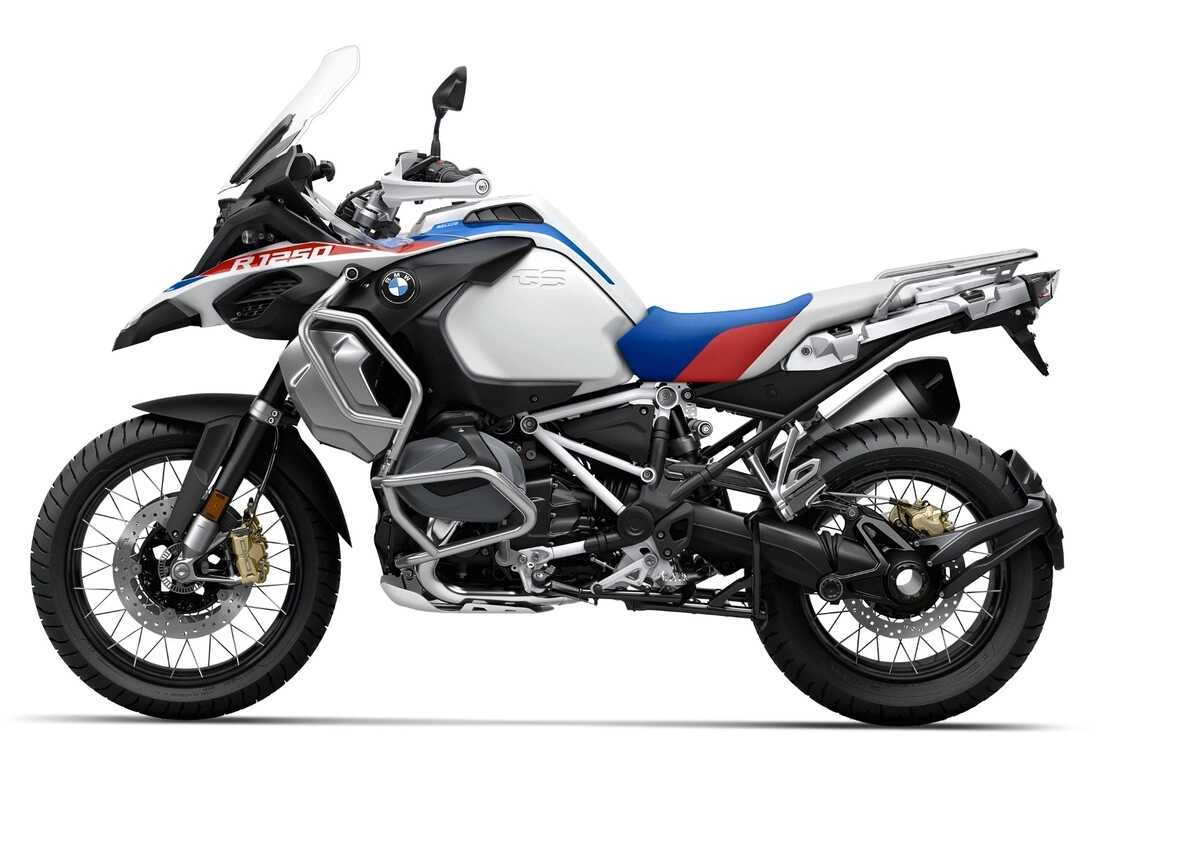
The BMW R 1250 GS is one of the defining motorcycles of modern adventure touring. Its 1,254cc boxer platform provides enormous low- and mid-range torque and the comfort needed for consecutive days in the saddle. BMW documentation for the 1250 platform lists the 1,254cc boxer engine with 100kW/136hp and 143Nm in this generation.
On Vietnamese roads, the GS shines when the journey combines:
mountain asphalt + long touring days + fast open sections + moderate gravel.
It is superb for routes such as:
Hanoi – Mai Chau – Son La – Dien Bien – Sapa;
Hanoi – Ba Be – Cao Bang – Hà Giang;
or the Ho Chi Minh Road toward Central Vietnam.
Where riders need respect for the machine is on tight, slippery or deeply rutted terrain. A large ADV motorcycle carries significant mass, and once traction disappears on a steep muddy climb, horsepower is rarely the solution.
For confident GS riders, however, carving through a dry mountain pass with the boxer engine driving from one corner to another can be an unforgettable EPIC RIDE.
Best suited to: experienced road and adventure riders who value comfort, torque and long-distance capability.
Ideal terrain: 75–90% paved mountain roads with gravel, rough tracks and light off-road sections mixed in.
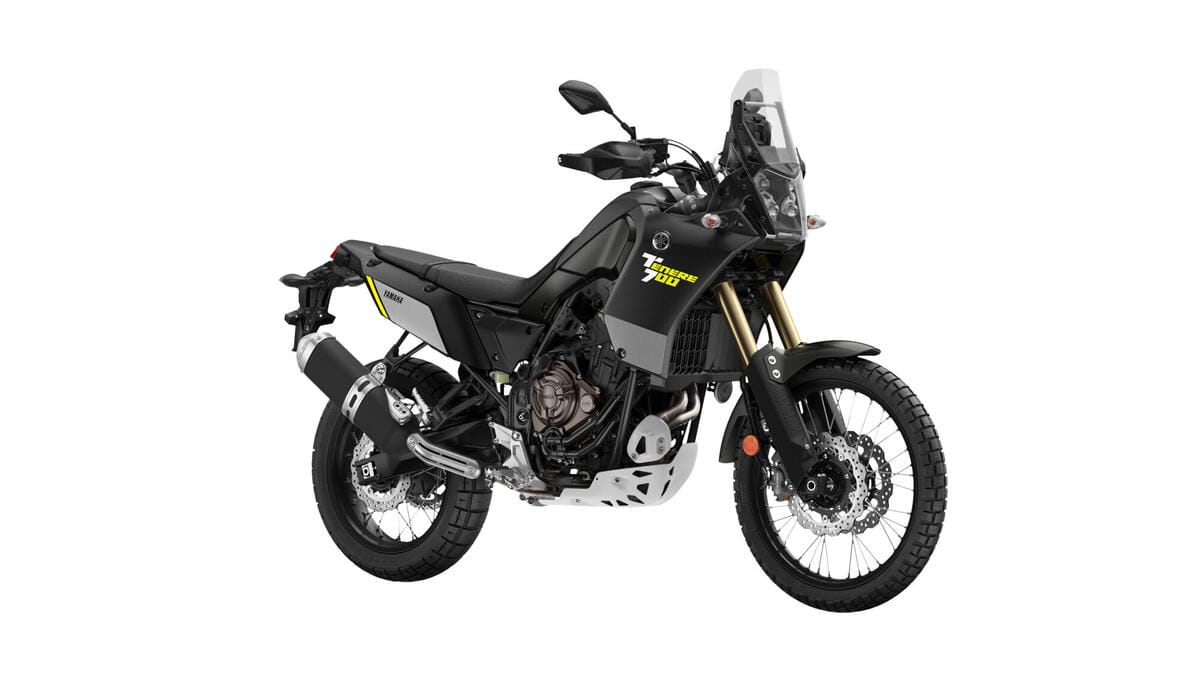
Yamaha Ténéré 700 – Our Choice for the More Off-Road-Focused Rider
If the BMW feels like a world traveller that can tackle dirt, the Yamaha Ténéré 700 feels more like a rally-inspired dirt traveller that happens to be comfortable on the road.
The current Ténéré 700 uses Yamaha’s 689cc CP2 parallel-twin engine and 21-inch front/18-inch rear spoke-wheel configuration — dimensions that make immediate sense when roads become rough.
This is where the T7 starts to feel at home:
broken roads, dirt tracks, rocky climbs, wild mountain trails and muddy connections.
Its manageable power delivery lets a skilled rider concentrate on balance and traction rather than controlling excessive horsepower.
For riders wanting a Vietnam ADV trip containing a meaningful percentage of dirt, the Ténéré is often the sweet spot.
It is particularly appealing for:
- Ta Xua backroads;
- Ngoc Chien mountain tracks;
- remote Northwest Vietnam;
- forest connections;
- Northeast border routes;
- mixed-surface sections of the Ho Chi Minh Road.
The T7 does not make difficult terrain easy — no motorcycle does — but it generally asks less physical effort than a heavyweight ADV once the road becomes genuinely rough.
Best suited to: intermediate-to-advanced adventure riders who enjoy standing on the pegs and actively riding the terrain.
Ideal terrain: 50–80% asphalt with substantial gravel, broken roads and optional off-road tracks.
Honda XL750 Transalp – The Balanced All-Rounder
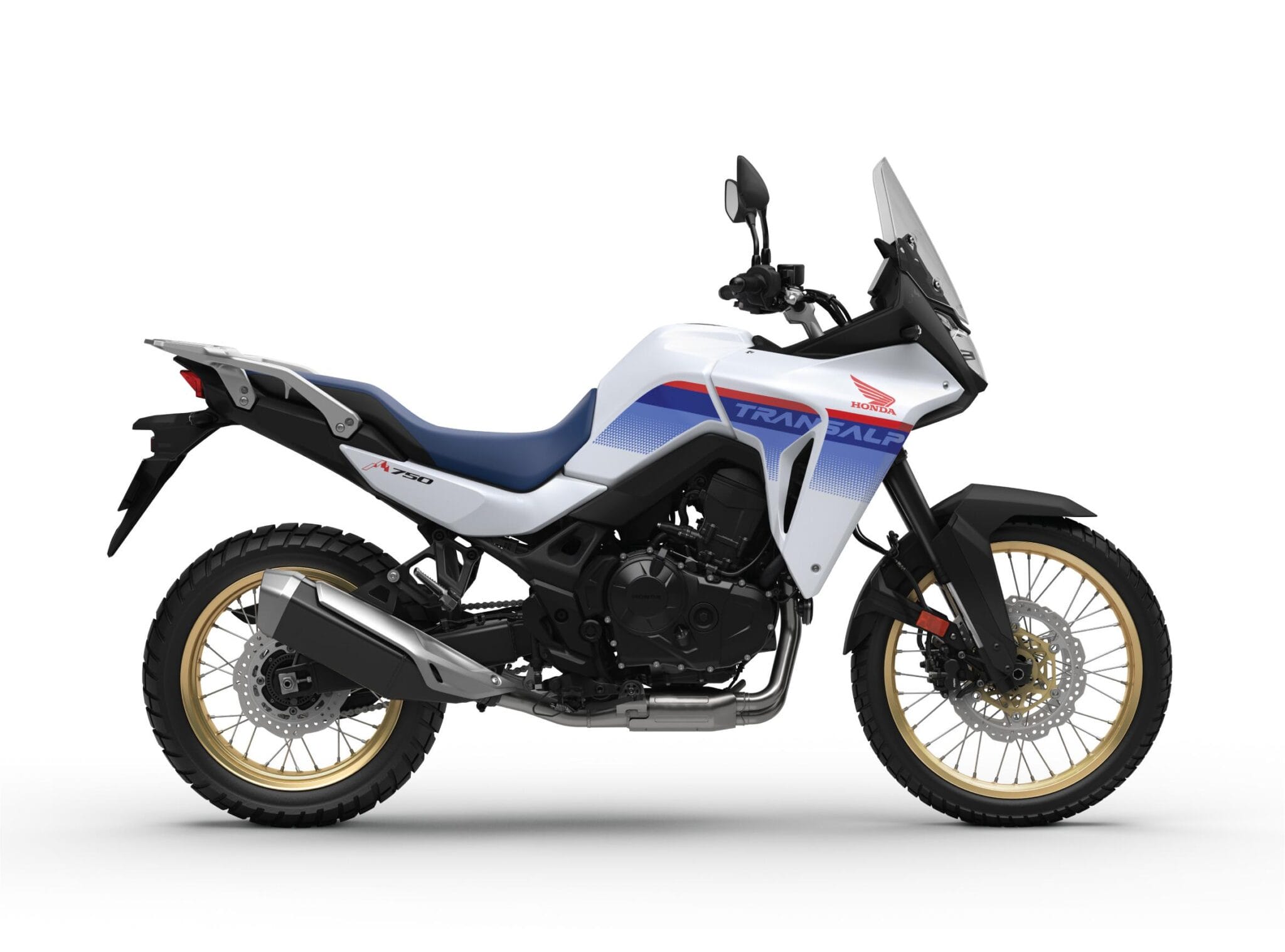
The Honda XL750 Transalp sits beautifully between the two personalities.
Honda currently equips the Transalp with a 755cc parallel-twin engine, while official specifications list an 850mm seat height and around 210–216kg kerb weight depending on market/version. Honda also describes the bike as intended for use across dirt tracks, city streets and open-road touring.
That versatility makes considerable sense in Vietnam.
The Transalp feels less intimidating than the GS in tight terrain but more relaxed than many dirt-biased motorcycles when the day stretches beyond 200 kilometres.
It handles:
twisted roads, mountain passes, rough provincial routes, gravel and moderate off-road riding
without requiring the rider to make major compromises.
If someone asks us:
“I want one motorcycle for a two-week Vietnam adventure, including mountain roads, dirt and long touring days. What should I ride?”
The Transalp is one of the easiest answers.
Best suited to: experienced touring riders moving into ADV riding, as well as seasoned riders looking for a versatile middleweight.
Ideal terrain: approximately 65–85% asphalt with gravel and moderate off-road.
Top Adventure Big Bike Tours in Vietnam You Should Ride
The following routes are not simply scenic roads.
They are journeys that combine riding quality, landscapes, history, culture and the kind of unpredictability that makes adventure travel memorable.
1. The Grand Northern Vietnam ADV Loop
Hanoi – Ba Be – Cao Bang – Ban Gioc – Meo Vac – Dong Van – Ha Giang – Sapa – Mu Cang Chai – Ta Xua – Mai Chau – Hanoi
Recommended duration: 10–14 days
Riding level: Intermediate to Advanced
Best motorcycles: Ténéré 700 / Transalp / BMW GS
Character: Mountain twisties, karst passes, villages, gravel, remote roads and optional dirt tracks
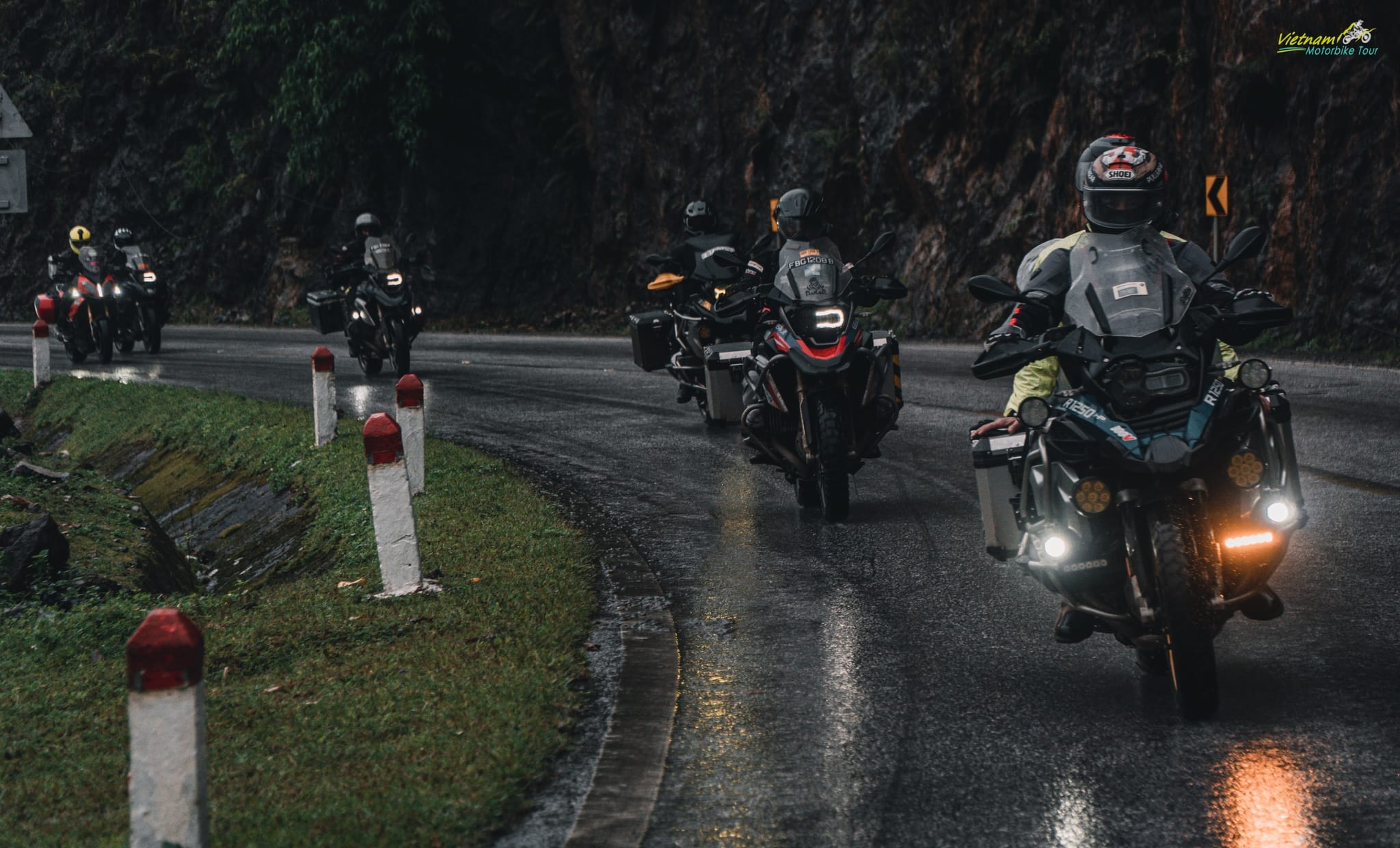
If there is one route capable of showing a rider why Vietnam deserves a place among the world’s great ADV destinations, this is it.
Leaving Hanoi, urban density slowly gives way to rice paddies and limestone hills. By the time you reach Ba Be National Park, the city feels much farther away than the kilometres suggest.
From Ba Be the journey pushes toward Cao Bang and Ban Gioc, then deeper into the frontier mountains.
The riding becomes increasingly dramatic.
Roads climb above valleys where cornfields are cut into slopes almost too steep to cultivate. Small villages appear around blind corners. Women in colourful ethnic dress walk beside the road carrying baskets of vegetables or firewood.
Eventually the route enters Dong Van Karst Plateau and Ma Pi Leng, one of the emotional high points of riding in Northern Vietnam.
Vietnam Tourism’s recommended Hà Giang road trip follows QL4C through the plateau and describes a circuit through the region’s remote mountain landscapes.
Yet the Northern Adventure does not end there.
Turn west and the landscape changes again.
The limestone fortress of Hà Giang gradually gives way to the high mountains around Sapa, followed by the spectacular rice-terrace country of Mu Cang Chai.
Then comes Ta Xua.
When conditions are dry, experienced riders can explore smaller mountain roads and dirt connections around the ridge. When it rains, the personality changes completely: harmless-looking earth can turn into MUDDY ROADS where throttle control and balance become more important than engine capacity.
That is exactly why this journey is better with an experienced local road captain.
Why riders love this route
Because almost nothing repeats itself.
Karst.
Rice terraces.
Forest.
High passes.
River valleys.
Remote villages.
Fast asphalt.
Broken roads.
Wild tracks.
And sometimes, after climbing all morning, a sea of clouds spreading beneath your motorcycle.
Which bike would we choose?
Ténéré 700: best if you want more off-road detours.
Transalp: arguably the best all-round option.
BMW GS 1250: magnificent for confident big-bike riders, provided the route is adapted when heavy rain turns tracks technical.
2. Hà Giang & Northeast Vietnam Big Bike Expedition
Hanoi – Ba Be – Cao Bang – Ban Gioc – Bao Lac – Meo Vac – Dong Van – Ha Giang – Hanoi
Recommended duration: 7–9 days
Riding level: Intermediate
Best motorcycles: BMW GS / Transalp / Ténéré 700
Character: Spectacular mountain asphalt, endless curves and frontier culture
For riders with only one week, this is perhaps the strongest Adventure Big Bike Tour Vietnam can offer.
The Hà Giang Loop itself travels through Quản Bạ, Yên Minh, Đồng Văn and Mèo Vạc, and Vietnam’s tourism authority describes the route as crossing high passes and deep valleys with repeated curves requiring skilled steering.
But starting directly in Hà Giang misses part of the story.
Approaching through Ba Be, Cao Bang and Bao Lac turns the experience into a true expedition.
You gradually ride away from the lowlands and into border country rather than simply arriving there by bus.
The road from Cao Bang toward the frontier is particularly rewarding for big bikes: long stretches of flowing tarmac punctuated by rough sections, local traffic and villages.
Then the mountains tighten around you.
Ma Pi Leng – when the road becomes theatre
There are mountain roads that are beautiful.
Then there are roads where you instinctively stop talking.
Ma Pi Leng is one of them.
The asphalt clings to enormous limestone slopes above the Nho Que River. Cornfields occupy improbable patches of rock. Small communities sit in valleys apparently separated from the modern world by walls of stone.
This is where a GS rider can enjoy the torque of the boxer engine, while the Ténéré rider enjoys the lightness of the bike through repeated direction changes.
But the landscape deserves restraint.
This is not somewhere to chase speed.
You ride to see.
You stop often.
You drink tea in roadside houses.
You watch clouds move through the valley.
That is the difference between riding through Hà Giang and actually experiencing Hà Giang.
3. Northwest Vietnam: High Passes, Rice Terraces & Wild Tracks
Hanoi – Mai Chau – Moc Chau – Son La – Dien Bien – Lai Chau – Sapa – Mu Cang Chai – Ngoc Chien – Ta Xua – Hanoi
Recommended duration: 8–11 days
Riding level: Intermediate to Advanced
Best motorcycle: Ténéré 700 / Transalp
GS suitability: Excellent when technical tracks are bypassed
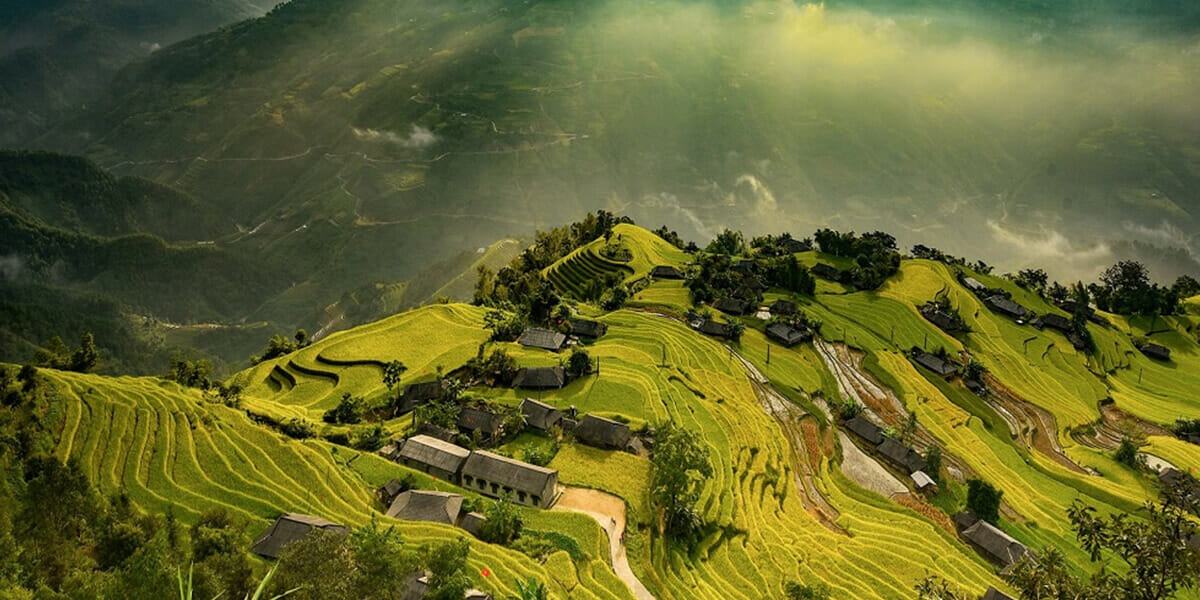
Northern Vietnam has two very different personalities.
The Northeast is dominated by limestone.
The Northwest feels bigger.
Valleys are wider, mountain ranges higher and distances between major stops longer. The road rises and falls over immense passes before dropping into valleys inhabited by Thai, Hmong, Dao and other ethnic communities.
For big-bike riders, this means wonderfully varied days.
One morning may involve smooth sweepers above Mai Chau.
The following day you may be negotiating damaged backroads after seasonal rain.
Later, around Ta Xua or Ngoc Chien, an optional dirt road may disappear into forest.
This is ADV country.
More than just an EPIC RIDE
It would be easy to market Northwest Vietnam purely through dramatic photographs.
But much of its character lies in what happens between the viewpoints.
A roadside lunch where nobody speaks English.
Children returning from school on bicycles.
Smoke rising from a Black Hmong kitchen.
Tea shared with a family while rain hammers against a corrugated roof.
These moments change the tempo of the journey.
An experienced international rider quickly discovers that Vietnam rewards curiosity as much as riding skill.
Ta Xua and Ngoc Chien: where tyre choice starts to matter
Dry mountain dirt can be surprisingly friendly.
Wet mountain dirt is another story.
Clay, mud, polished rocks and steep gradients can transform an easy trail into a physical challenge.
On a Ténéré 700, a strong off-road rider may actively seek these sections.
On a BMW GS loaded with luggage, the sensible option may be a parallel asphalt or concrete route.
Neither choice makes the adventure more or less authentic.
The correct route is the one that matches rider + motorcycle + conditions.
That principle should sit at the heart of every professional ADV Motorcycle Tour Vietnam.
4. Ho Chi Minh Road Adventure: Hanoi to Hoi An
Hanoi – Pu Luong – Tan Ky – Phong Nha – Khe Sanh – DMZ – Hue – Hai Van Pass – Hoi An
Recommended duration: 8–10 days
Riding level: Intermediate
Best motorcycles: BMW GS 1250 / Transalp / Ténéré 700
Character: Long-distance ADV touring, jungle roads, history and sweeping mountain riding
For riders who prefer journey and history over technical dirt, the Ho Chi Minh Road deserves serious attention.
This is arguably where the BMW GS feels most at home.
Leaving Hanoi, the ride first reaches the limestone valleys and rice landscapes around Pu Luong before continuing toward Tan Ky, an area associated with the historic Ho Chi Minh trail system.
Farther south, forests close around the road as you approach Phong Nha-Ke Bang.
Vietnam Tourism specifically recommends exploring countryside around Phong Nha via the Ho Chi Minh Highway, noting the quiet rural scenery surrounding the area.
This is adventure touring in a different form.
Not extreme.
Not constantly technical.
But deeply satisfying.
Long green roads disappear into mountains.
Traffic thins.
Villages become less frequent.
And the sound of an ADV twin or boxer begins to feel perfectly matched to the landscape.
Riding through history
The route eventually reaches Khe Sanh and the former Demilitarized Zone.
For many Western riders, particularly those from the United States and Australia, this part of the journey has an emotional dimension that cannot be captured by riding statistics.
Names once encountered in history books become physical places.
Rivers.
Hills.
Airfields.
Villages.
The experience is best approached respectfully and with historical context from a knowledgeable guide rather than reduced to battlefield sightseeing.
The road then heads toward the former imperial capital of Hue before finishing with one of Vietnam’s classic motorcycle rides: Hai Van Pass.
Vietnam Tourism describes the Hoi An–Hue ride as roughly 150km without detours and highlights the windy climb over Hai Van Pass as the centrepiece of the journey.
One day you are riding through forests once associated with wartime supply routes.
The next you are leaning through coastal curves above the East Sea.
Few motorcycle countries offer transitions quite like that.
5. The Grand Vietnam ADV Motorcycle Tour – Hanoi to Saigon
Hanoi – Northwest or Northeast Vietnam – Ho Chi Minh Road – Phong Nha – Hue – Hoi An – Kon Tum – Central Highlands – Buon Ma Thuot – Da Lat – Southern Vietnam – Saigon
Recommended duration: 15–21 days
Riding level: Intermediate
Best motorcycle: BMW GS / Transalp
Ténéré 700: Excellent for riders wanting extra dirt sections
Some trips are holidays.
Others become milestones.
A Hanoi to Saigon ADV Motorcycle Tour belongs firmly in the second category.
Vietnam stretches more than a thousand kilometres from north to south, yet simply riding Highway 1 would miss most of what makes the country special.
The better motorcycle journey follows mountains.
You begin among the highlands of the north, connect with the Ho Chi Minh Road, cross Central Vietnam and then turn inland again into the Central Highlands.
The climate changes.
Architecture changes.
Food changes.
Coffee plantations replace northern rice terraces.
The cultures of the highland communities differ from those encountered around Hà Giang or Sapa.
Eventually, the cool mountain roads around Da Lat descend toward warmer Southern Vietnam.
By the time Saigon traffic surrounds you, the quiet mountain where you began two weeks earlier seems like another country.
That geographical and cultural transition is the real value of a Vietnam cross-country motorcycle expedition.
It is not merely about being able to say:
“I rode from Hanoi to Saigon.”
It is about understanding how dramatically Vietnam changes between those two cities.
What Are Vietnam’s Roads Really Like for Big Bikes?
This may be the most important section of the entire guide.
Vietnam motorcycle marketing often shows empty roads and perfect mountain curves.
Those roads exist.
So do:
- trucks crossing the centre line;
- scooters joining without warning;
- livestock;
- gravel on corners;
- road repairs;
- potholes;
- fog;
- wet concrete;
- landslides after prolonged rain;
- steep hairpins;
- construction vehicles;
- children and pedestrians in villages.
The UK government’s current Vietnam travel advice tells riders to remain alert, notes inconsistent compliance with road rules and specifically recommends experienced riders, reputable rental organisations, proper helmets and appropriate travel insurance.
Vietnam therefore rewards defensive riding.
A rider who tries to impose European or Australian road expectations on rural Vietnam will become frustrated.
A rider who learns to read the local rhythm begins to enjoy it.
The golden rule: never ride faster than you can see
Blind mountain corners are genuinely blind.
Assume there may be:
a truck,
a buffalo,
loose gravel,
a stopped scooter,
or half the road missing around the next bend.
This does not make riding Vietnam unpleasant.
Quite the opposite.
It makes precision, observation and judgement part of the adventure.
Single Trails, Jungle Tracks and Muddy Roads: How Much Off-Road Should You Book?
The answer depends on your real experience — not the experience you wish you had.
There is an enormous difference between:
“I have ridden gravel roads.”
and:
“I regularly ride a 220kg adventure bike standing up through steep rocky terrain.”
Before booking an off-road ADV itinerary, a responsible operator should ask about:
- motorcycle currently owned;
- years of riding;
- off-road experience;
- motorcycles previously ridden off-road;
- ability to ride standing;
- mud experience;
- sand experience;
- steep ascent/descent experience;
- recent riding frequency;
- physical condition;
- passenger or luggage requirements.
For BMW GS riders
We generally recommend flowing ADV terrain rather than extreme enduro terrain.
Gravel?
Absolutely.
Broken mountain roads?
Yes.
Dry dirt tracks?
Perfect.
Moderately technical forest roads?
For experienced riders, yes.
Deep mud and narrow single trails on a fully loaded GS?
Usually unnecessary.
For Ténéré 700 riders
More technical routes become realistic.
A capable rider can enjoy:
single trails, jungle roads, rocky climbs, wild tracks and muddy sections, provided the route remains appropriate and legally accessible.
For Transalp riders
The sweet spot lies between both worlds: plenty of rough-road exploration without designing the entire trip around technical enduro riding.
Best Time for Adventure Motorcycle Tours in Vietnam
There is no single “perfect month” for the entire country because Vietnam covers multiple climatic regions.
That is another reason route design matters.
For Northern Vietnam, many riders favour the drier and cooler periods when mountain visibility is generally better and prolonged summer rain is less dominant. Hà Giang tourism information particularly highlights seasonal landscapes such as golden rice around September and October.
However, weather in mountain regions can change quickly.
Mist may appear even in a normally favourable month.
Rain may alter a dirt section overnight.
Temperatures at altitude can feel much cooler than Hanoi.
Practical ADV approach
Do not choose a departure date based only on average monthly weather charts.
Instead ask:
- Which region are we riding?
- How much off-road is planned?
- What tyres are fitted?
- Does the itinerary have weather alternatives?
- Can the guide replace a muddy technical section with another scenic route?
That flexibility often makes the difference between an adventure and an ordeal.
Riding Licence, IDP and Insurance: Read This Before Booking
This area deserves particular care for international riders because requirements can differ according to your nationality, home licence and the convention under which your International Driving Permit was issued.
Do not assume that possessing “an IDP” automatically makes you legal.
For example, current UK government travel advice says UK riders in Vietnam need the 1968-version IDP together with their UK driving licence and reminds travellers that appropriate insurance is required.
Vietnam has participated in the 1968 Vienna Convention framework, but the exact legal solution may differ for riders whose home countries do not issue the relevant permit. Vietnam Law Magazine also notes the country’s participation in the Convention and the framework for eligible foreign residents.
The U.S. Embassy in Vietnam advises foreigners who need a Vietnamese driving or motorcycle licence to contact the relevant Vietnamese traffic-police authority.
Before paying your tour deposit, confirm:
- your domestic licence includes the correct motorcycle category;
- whether your country issues a 1968 Vienna Convention IDP;
- whether that combination is accepted for your intended motorcycle capacity;
- whether another Vietnamese licensing procedure is required;
- whether your travel insurance covers motorcycle riding at the planned engine capacity;
- whether off-road riding is covered;
- whether medical evacuation is included;
- what motorcycle third-party insurance applies locally.
For US and Australian riders in particular, ask the operator to check your exact documentation rather than relying on generic advice intended for European travellers.
Regulations and enforcement can change.
Written confirmation before arrival is far better than discovering a problem at a roadside checkpoint.
And one rule should never require interpretation:
do not drink and ride.
Current UK travel advice warns that drink-driving laws in Vietnam are strict and that alcohol can lead to serious penalties.
What Should a Professional Vietnam Big Bike Tour Include?
A premium ADV tour should be much more than motorcycle rental plus a guide.
Recommended Tour Inclusions
A professionally operated Adventure Big Bike Tour Vietnam should normally include:
- selected adventure motorcycle as confirmed;
- motorcycle rental for the entire riding period;
- experienced English-speaking motorcycle road captain;
- pre-tour riding and safety briefing;
- route planning appropriate to rider skill;
- quality accommodation at hotels, lodges or selected homestays;
- meals according to the confirmed itinerary;
- drinking water during riding days;
- fuel as specified in the quotation;
- motorcycle maintenance and basic technical support;
- spare tubes or tyre-repair equipment where applicable;
- tools and essential spare parts;
- luggage solution or support vehicle where included;
- entrance fees for scheduled attractions;
- local cultural experiences;
- route adjustments due to weather or road conditions;
- emergency support procedures.
For larger groups or long cross-country journeys, a support vehicle can be extremely valuable.
It carries luggage, spare parts and sometimes a replacement motorcycle, allowing riders to enjoy the bike without turning it into a two-wheeled moving house.
What We Would Check Before Handing You a Big Bike
The motorcycle matters.
Its preparation matters more.
Before departure, riders should inspect the machine together with the tour team.
Essential pre-ride check
Tyres: correct condition and tread for the route.
Brakes: pads, discs and lever feel.
Chain and sprockets: particularly on Ténéré and Transalp-type motorcycles.
Final drive: inspect where applicable.
Engine oil and coolant: correct levels.
Suspension: preload appropriate to rider and luggage.
Lights and indicators: working correctly.
Controls: clutch, throttle and brake adjusted comfortably.
Crash protection: especially important on ADV motorcycles.
Handguards and engine protection: strongly recommended.
Tool kit and puncture equipment: accessible.
Luggage: secure and positioned so it cannot interfere with rear wheel or exhaust.
A premium motorcycle with poor tyres is not a premium tour.
What Riding Gear Should You Bring?
Vietnam may look tropical on a map, but a cold wet morning above 1,500 metres feels very different from an afternoon in Hanoi.
Layering works better than packing one heavy jacket.
We recommend:
- certified full-face or ADV helmet;
- armoured motorcycle jacket;
- riding trousers with protection;
- proper motorcycle boots;
- summer and waterproof gloves;
- lightweight waterproof outer shell;
- breathable base layers;
- thermal layer for northern winter departures;
- hydration pack;
- neck protection or buff;
- sunglasses;
- compact personal first-aid items;
- waterproof phone/passport protection.
For routes containing real off-road sections, proper ADV or enduro boots are substantially preferable to casual touring shoes.
Who Should Book a Vietnam Big Bike Tour?
These journeys suit riders who enjoy the process of travelling, not simply reaching the next hotel.
You will probably love this style of trip if:
you own or regularly ride an adventure motorcycle;
you enjoy mountain roads more than motorways;
you do not mind getting dusty;
you can accept changing plans;
you want to meet local people;
you are comfortable with unfamiliar traffic;
and you believe the best road is not necessarily the fastest one.
You may want a less demanding touring itinerary if you dislike gravel, rarely ride motorcycles at home or expect Western highway standards throughout the journey.
There is no shame in choosing an easier route.
The objective is not to prove something.
The objective is to return home thinking:
I would ride that again tomorrow.
Frequently Asked Questions About Vietnam Adventure Big Bike Tours
1. Is Vietnam suitable for BMW R 1250 GS motorcycles?
Absolutely, particularly for mountain touring, Ho Chi Minh Road journeys and mixed paved/gravel itineraries.
The route should simply avoid unnecessary technical single-track when conditions become wet or extremely rough.
2. Is the Ténéré 700 better than the BMW GS for Vietnam?
Neither is universally better.
The Ténéré 700 is generally easier on technical dirt and rough tracks.
The BMW GS offers exceptional comfort, road performance and long-distance capability.
Choose according to your riding style rather than badge preference.
3. Is the Honda Transalp suitable for a two-week Vietnam tour?
Yes.
Its combination of middleweight size, road comfort and off-road capability makes the Transalp especially well suited to mixed-surface Vietnam journeys. Honda positions the current XL750 specifically as a versatile adventure platform for dirt tracks and open-road touring.
4. How many kilometres should we ride each day?
A typical mountain day may cover roughly 150–250km, but distance is a poor measure of difficulty.
Two hundred kilometres through steep passes and villages may take most of the day.
Vietnam is rarely a destination where chasing daily mileage improves the experience.
5. Do I need off-road riding experience?
For primarily paved big-bike tours, strong road-riding experience may be enough.
For tours advertised with single trails, muddy roads, jungle tracks or technical off-road, prior off-road experience is strongly recommended.
Be accurate when describing your skill level.
6. Can beginners ride a BMW GS in Northern Vietnam?
We would not recommend a heavyweight big-bike expedition for a true beginner.
Northern Vietnam combines demanding traffic, sharp curves, steep roads and unpredictable surfaces.
The UK government’s Vietnam advice similarly recommends avoiding motorcycle hire if you are not an experienced rider.
7. Can I bring a pillion passenger?
Yes on appropriately designed touring routes.
A GS or Transalp can work very well two-up on asphalt-focused journeys.
However, difficult off-road sections should normally be reduced or eliminated when carrying a passenger.
8. What happens if heavy rain makes an off-road trail impossible?
A professional guide should change the route.
The itinerary should never become a competition against the weather.
Vietnam has enough alternative roads that a changed route can still produce a superb riding day.
9. Is Hà Giang the best ADV route in Vietnam?
It is certainly one of the most visually dramatic and is promoted by Vietnam Tourism specifically as an outstanding two-wheel road-trip destination.
But riders wanting more dirt may prefer the Northwest, while riders seeking a longer historical journey may prefer the Ho Chi Minh Road.
10. How long is the ideal first Vietnam big-bike trip?
For most experienced international riders, 8–12 riding days is an excellent first journey.
It provides enough time to escape the major highways, settle into Vietnamese traffic and explore remote regions without rushing every day.
If time allows, a 15–21 day Hanoi-to-Saigon expedition becomes a completely different level of adventure.
Final Thoughts: Vietnam Is Not a Motorcycle Playground — It Is a Country You Experience by Motorcycle
Adventure motorcycles have become extraordinarily capable.
A BMW GS can cross continents.
A Ténéré 700 can disappear into rough country for days.
A Transalp can move effortlessly between motorway, mountain road and dirt.
But the motorcycle is only the instrument.
Vietnam is the experience.
The real memories are rarely horsepower figures.
They are the morning mist lifting over Hà Giang.
The smell of wood smoke in a mountain village.
A bowl of steaming pho after four hours in the rain.
The guide stopping at an unmarked junction because he knows a better road.
The sudden silence when the engines are switched off above Ma Pi Leng.
The muddy boots outside a homestay.
The laughter after helping another rider pick up his bike.
The sight of the Ho Chi Minh Road disappearing into jungle.
And that final evening when the motorcycles are parked, cold beers arrive and everyone begins retelling the same corners as though the journey happened years ago instead of hours.
That is what the best Adventure Big Bike Tours in Vietnam should deliver.
Not simply kilometres.
Not simply photographs.
And certainly not an artificial promise of “extreme off-road” every day.
A great ADV journey balances EPIC RIDES, twisted mountain roads, steep passes, wild tracks, cultural encounters, local history, challenging terrain and enough flexibility to follow the road Vietnam gives you that day.
Ride the BMW GS if you love torque and long-distance confidence.
Choose the Ténéré 700 if dirt makes you smile.
Take the Transalp if you want the middle ground.
Then point the front wheel north, south or toward the mountains.
Vietnam will do the rest.