
Why Laos Feels Made for Two Wheels
There’s a particular hush to Laos that riders notice before they can explain. It’s in the way dawn mist hangs over the Nam Ou, in the slow rhythm of wooden boats on the Mekong, in the golden quiet of temple courtyards where saffron robes move like flame through shade. Laos doesn’t rush you. It invites you to arrive properly—mile by mile, village by village, with your hands on the bars and your senses wide open.
For adventure travelers, Laos is one of Southeast Asia’s rare motorbike frontiers that still feels authentic. The north offers mountain switchbacks, limestone valleys, and dirt tracks that thread through Hmong and Khmu communities. The central corridors open into karst landscapes around Vang Vieng and rugged countryside beyond. And wherever you ride, you’ll encounter a culture shaped by Buddhist traditions, a deep respect for community, and an understated warmth that makes simple interactions—buying a coffee, asking for directions, waving at kids by the roadside—feel like part of the journey’s soul.
But here’s the honest truth: the freedom of a Laos motorbike trip comes with responsibility. In 2026, the two biggest pain points for riders are still the same:
- What’s actually legal (license, IDP, documents, local rules), and
- What insurance really requires (not what we hope it covers).
This guide is built to be a practical, trustworthy reference—written in the voice of a rider who has seen what happens when paperwork is “almost right.” It will help you understand the role of the International Driving Permit (IDP), what documents matter most during roadside checks and (more importantly) after an accident, and how to set yourself up to ride Laos legally and responsibly.
The Core Reality: “Rental-Approved” Is Not the Same as “Legally Covered”
In Laos (and across the region), it’s common to hear: “They rented me a bike, so I’m legal.” That assumption is where trouble begins.
Many rental shops will hand over keys with minimal checks. But legality is determined by local traffic law and enforcement, not by a rental counter. And insurance decisions are determined by policy terms, not by your intentions.
So, before we get into specifics, adopt this mental model:
+ Police checks care about documents, categories, and local compliance.
+ Insurance claims care about whether you were licensed correctly for that bike, whether you followed conditions (helmet, alcohol exclusions, etc.), and whether your documents are valid and consistent.
This guide will help you align all three: law + enforcement reality + insurance conditions.
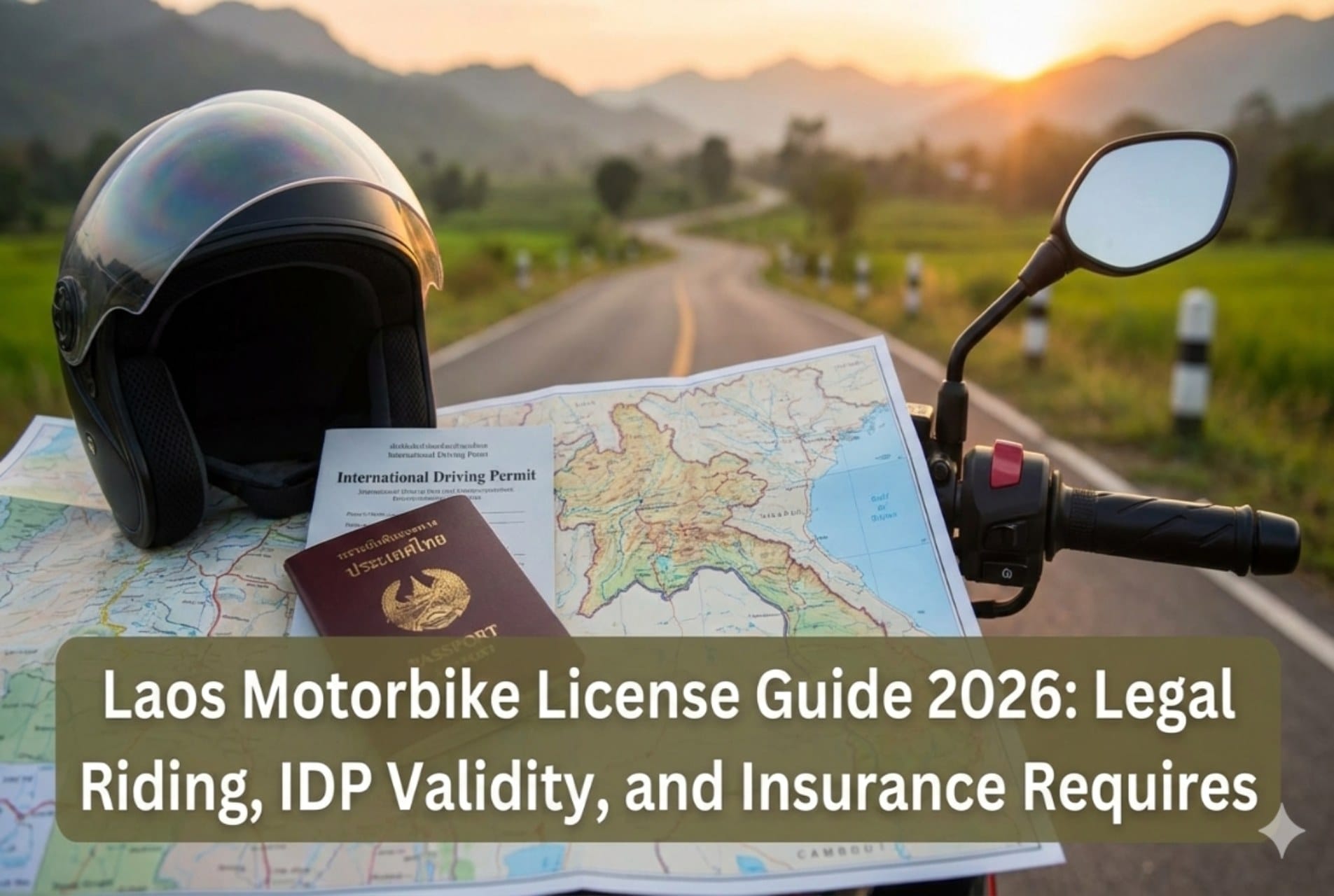
What Documents You Should Carry in Laos for Motorbike Riding
The “Gold Standard” Document Set
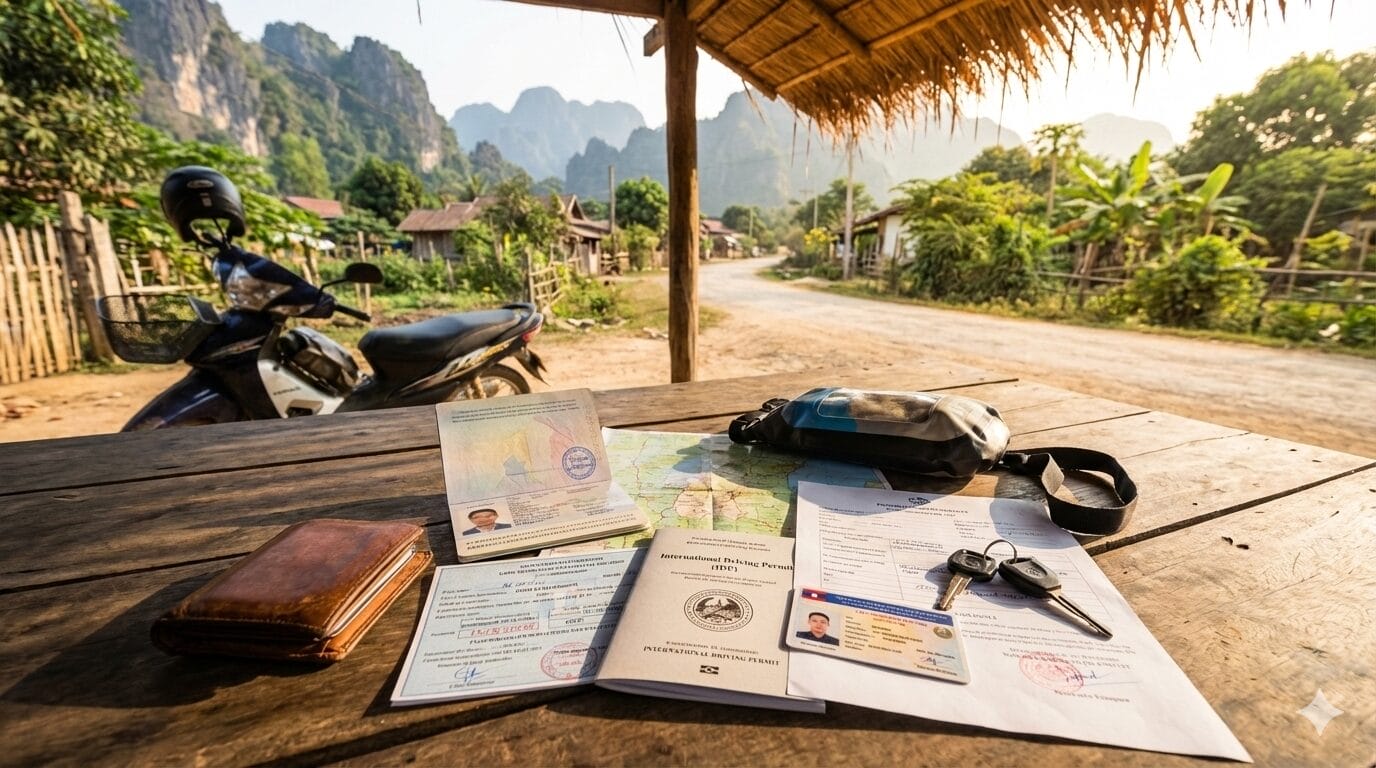
For the highest chance of legal compliance and smooth interactions, riders should carry:
- Passport (or a copy + entry stamp/visa copy)
- Home-country motorcycle driving license (correct category for motorcycles)
- International Driving Permit (IDP) that matches the convention Laos recognizes/accepts in practice
- Rental/ownership paperwork (rental agreement; if private bike, proof of ownership/registration)
- Insurance documentation (your travel insurance policy certificate + emergency contact details)
Many tour operators and rider guidance sites summarize the same core list: home license + IDP +
passport + rental agreement + insurance.
Why copies matter (and how to do it smart)
Carry originals where required, but also keep waterproof copies in a separate pouch and offline digital copies on your phone. In a wet season downpour, your “perfect paperwork” can turn into pulp. Laos is forgiving in spirit, but paperwork is still paperwork.
Understanding the IDP: What It Is (and What It Isn’t)
IDP basics in one clear sentence
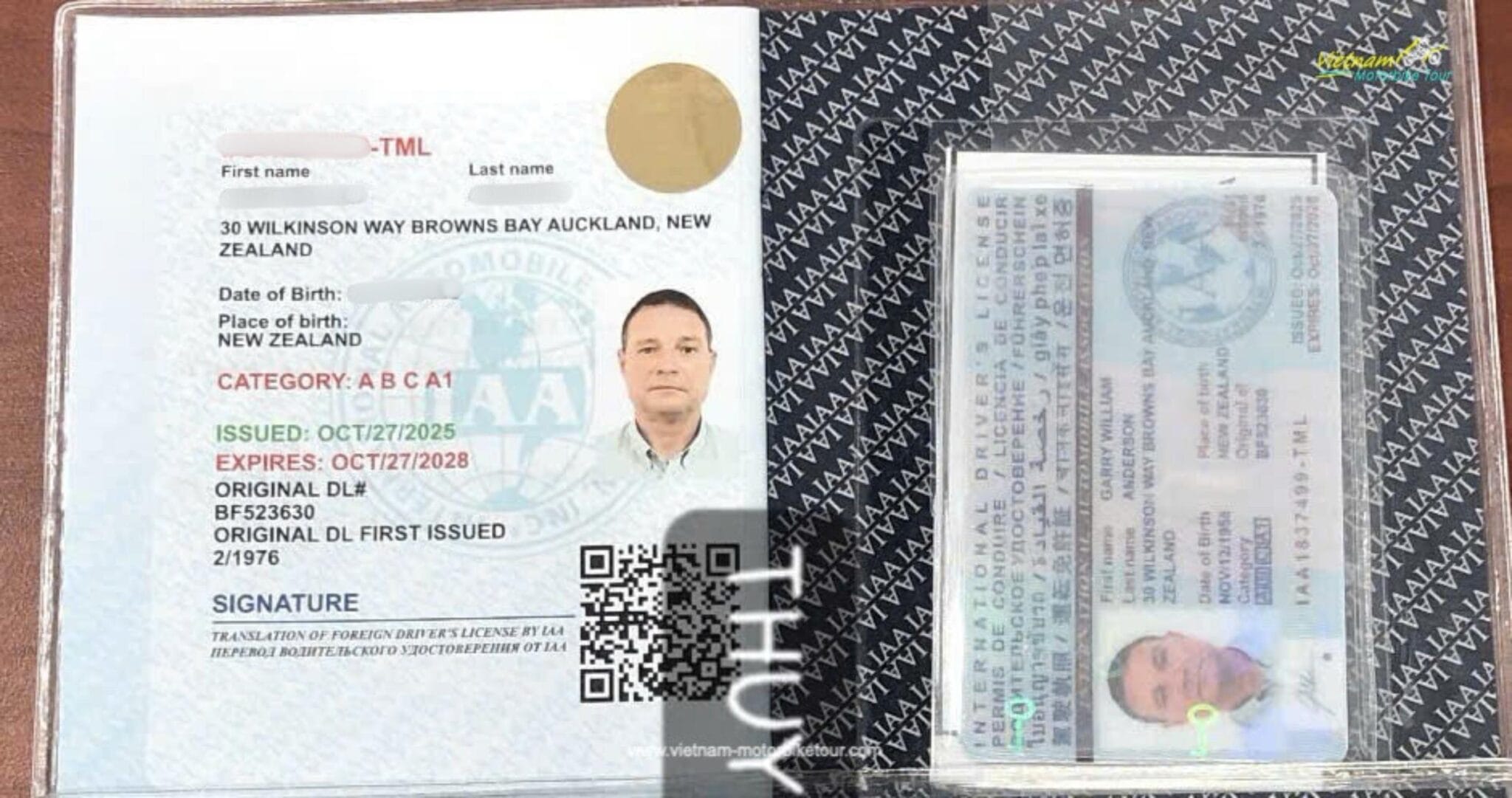
An International Driving Permit (IDP) is essentially a standardized translation of your domestic driving license, governed by international conventions (not a standalone license).
That means:
+ An IDP is only valid when carried together with your real, domestic license.
+ It must reflect the correct vehicle categories (motorcycle vs car).
+ It doesn’t magically override local law—it helps authorities interpret your license.
The conventions: 1949 vs 1968 (why this matters in 2026)
IDPs are governed mainly by the 1949 Geneva Convention and the 1968 Vienna Convention (plus older historical frameworks).
Different countries issue different formats depending on which convention they participate in. This is why some riders show up with an IDP that looks legitimate—yet doesn’t match what local authorities expect.
Practical takeaway for riders:
Before you travel, confirm which IDP format your country can issue and which is most recognized for Laos in real-world enforcement. When in doubt, choose the option most widely accepted for your nationality and region—and avoid “instant online international licenses” that aren’t official IDPs.
(A note of caution: many websites advertise “international driver’s licenses” that are not official IDPs. When you rely on those, you risk being treated as unlicensed.)
What’s Legal in Laos in 2026: The Practical Interpretation Riders Need
The legal principle
At a minimum, you should expect that to ride legally you must be a properly licensed rider and comply with Laos traffic rules. Laos legal portals and official summaries emphasize that foreign transport/road users must comply with Lao PDR traffic rules and relevant laws
What many guidance sources say about foreigners driving in Laos
Several expat/legal guidance summaries state that foreigners can drive with an IDP or foreign license for a limited period, after which conversion may be required (especially for long stays).
Because this type of information can vary by visa type and local implementation, the safest approach is:
+ Short-term travelers: arrive with proper motorcycle license + IDP + insurance
+ Long-term residents: check conversion requirements and visa/work permit links before assuming eligibility
(This is practical travel guidance, not legal advice. If you need certainty for long stays, verify directly with relevant Lao authorities or your embassy.)
License Categories: The Mistake That Breaks Insurance
If your license doesn’t match your bike, you’re exposed
This is the single most common failure point in claims.
If you ride a dirt bike, dual-sport, or larger-displacement motorcycle without the correct motorcycle category on your domestic license and IDP, you may be treated as:
+ unlicensed, or
+ licensed for a different class, which for insurers can be the same as unlicensed in practice.
Even when enforcement on the road feels relaxed, insurers can be strict after an incident—especially if there’s injury, third-party damage, or evacuation costs.
What Police Checks Typically Focus On in Laos
In real-life roadside checks across Southeast Asia, the focus is rarely philosophical. It’s usually:
+ Do you have a helmet?
+ Do you have a license/IDP?
+ Are your documents coherent?
+ Are you riding safely / respectfully?
Helmet use is a core safety standard repeatedly emphasized in road safety materials and enforcement campaigns.
For tours, the professional standard is simple: helmet on and properly fastened, every ride—because legality aside, it’s the most basic protection you have.
How to behave in checks (this matters more than people think)
+ Slow down early, pull over safely, turn off the bike.
+ Be polite, calm, and patient.
+ Show documents neatly (a waterproof folder helps).
+ Avoid arguments or sarcasm. Laos culture values calm respect; you will almost always receive it back.
What Insurance Really Needs: The “Claim-Approved” Checklist
Insurance is where the gap between “tourist logic” and “legal reality” becomes expensive.
1) Riding must be covered in your policy
Many travel insurance providers offer optional cover for motorbike/scooter riding, but it’s often conditional. Some policies exclude riding entirely, some exclude above certain engine sizes, and many require you to be properly licensed. Community summaries of policy reading often highlight how common motorbike exclusions and engine-capacity conditions are.
2) You must be licensed correctly (domestic + IDP if required)
This is the big one. If your policy says you must hold a valid license “as required by local law,” insurers can deny claims where:
+ you don’t have the right motorcycle category, or
+ you lacked an IDP where it’s expected, or
+ you were in breach of local rules that the policy treats as conditions.
World Nomads, for example, flags motorbike/scooter riding as a key travel insurance consideration for Laos-region travel and encourages travelers to understand coverage conditions.
3) Protective gear and behavior conditions
Many policies include clauses around:
+ helmet requirement
+ alcohol/drug exclusions
+ reckless behavior exclusions
+ use of the vehicle within permitted activities (on-road vs off-road can matter)
Even if you’re riding a dirt bike tour, verify whether your insurer distinguishes between:
+ paved road riding
+ off-road/enduro riding
+ organized tours vs independent riding
4) Documentation after an incident
If something happens, insurers often require:
+ documentation of the event (local report if available)
+ medical records
+ proof you were licensed
+ proof of costs and payments
+ emergency contact calls to their assistance line before major expenses (evacuation, hospital deposits)
Rider habit that saves claims:
Carry your insurance emergency number offline and know your policy number by heart (or keep it on a laminated card).
The Responsible 2026 Approach: How to Ride Laos Legally and Reduce Risk
Step 1: Confirm your licensing path before booking
+ Do you hold a valid motorcycle license at home?
+ Can your country issue an IDP, and which convention format will it be?
+ Does your insurer explicitly cover motorbike riding in Laos?
If any answer is “not sure,” solve that before you commit to riding days in remote provinces.
Step 2: Choose a tour operator who supports compliance
+ A professional operator should:
+ brief riders on documents and safety
+ encourage legal compliance (not “don’t worry about it”)
+ plan routes with safety and conditions in mind
+ have contingency plans for rain, breakdowns, and emergencies
Step 3: Ride with cultural awareness
This isn’t only about law—it’s about keeping Laos welcoming for riders long-term:
+ slow down through villages
+ avoid aggressive throttle near homes, schools, temples
+ don’t ride intoxicated (ever)
+ respect local customs at spiritual sites
Frequently Asked Questions for 2026 Riders
Do I really need an IDP for Laos?
In practice, it’s strongly recommended to carry an IDP alongside your home motorcycle license, because it helps bridge language and category interpretation and is commonly referenced as the expected standard for foreign riders.
Can I buy a “quick online international license” and be fine?
Be careful. Many online “international licenses” are not official IDPs under the conventions and may not be accepted as valid driving documentation. The safest path is an IDP issued by an authorized body in your home country under the relevant convention framework.
What’s the most common reason insurance fails for motorbike accidents?
Licensing mismatch and exclusions. If your policy requires you to be properly licensed and compliant, then missing the correct motorcycle category or required documentation is a frequent failure point.
Does “no one checked me” mean I’m safe?
No. Roadside enforcement can be variable. Insurance assessment after an incident can be stricter and document-based.
Ride Laos with Freedom—and with Proof
Laos rewards riders who travel gently and prepared. It’s a country where adventure still feels personal: where a mountain pass can lead to a hidden village, where a rainstorm can turn the road into a lesson, and where the best moments often happen far from any “must-see” list.
But the deeper into Laos you ride, the more your safety depends on decisions made long before the first engine starts: your license category, your IDP validity, your insurance wording, and your respect for local rules. In 2026, the smartest riders are not the boldest—they’re the most prepared. They carry documents that make sense, they buy insurance that truly covers what they’re doing, and they ride in a way that keeps Laos beautiful for everyone who comes next.
If you want the real Laos—the one beyond the obvious roads—earn it the right way: legal where it matters, covered where it counts, and respectful everywhere.
Join our guided Laos motorbike tours designed for legal compliance, safety, and deep local access. Ride confidently with expert support, verified routes, and full documentation guidance throughout your journey.