
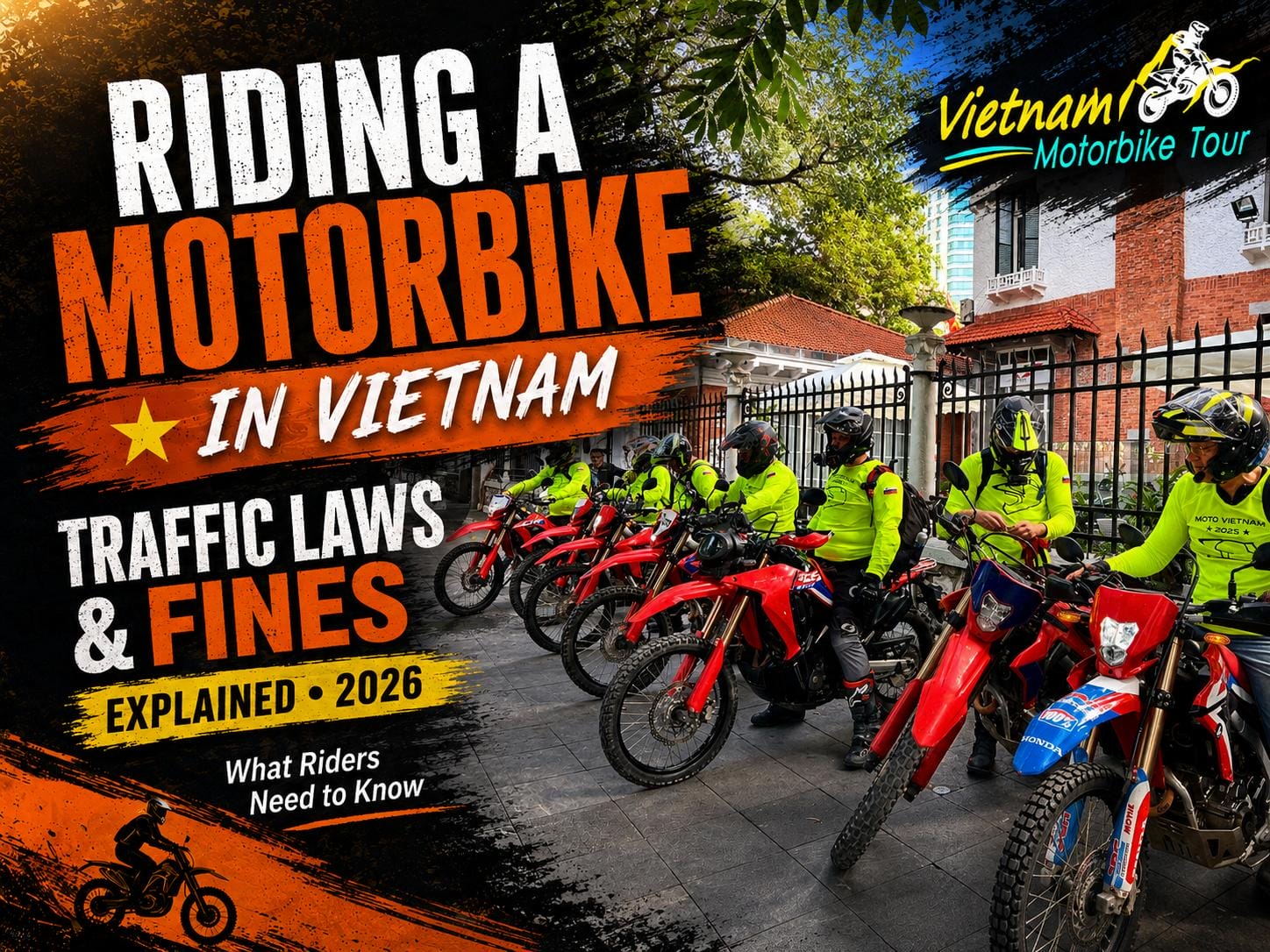
There is something wonderfully liberating about exploring Vietnam on two wheels.
Leave Hanoi behind at sunrise and the city slowly gives way to rice fields, limestone mountains and quiet village roads. Ride farther north and the landscape becomes increasingly dramatic: twisting passes, mist-covered valleys, ethnic minority villages and mountain roads that seem made for motorcycles. Head south and the journey changes again, from the Ho Chi Minh Trail to coastal highways, highland roads and tropical countryside.
For many international riders, a Vietnam motorbike tour becomes one of the most memorable journeys of their lives.
But there is another side to riding in Vietnam that every responsible traveller should understand before turning the key: Vietnamese traffic law applies to foreign riders just as it applies to local road users.
Vietnam has strengthened traffic enforcement significantly in recent years. Traffic cameras, automated monitoring systems and police enforcement are increasingly common, while penalties for several serious offences—including running red lights, speeding, riding under the influence of alcohol and dangerous riding—can be substantial.
The purpose of this guide is not to make riding in Vietnam sound intimidating.
Quite the opposite.
Understanding the rules allows you to relax, ride confidently and focus on what you came to Vietnam for: the landscapes, people, food, culture and extraordinary roads.
A good rider does not need to ride fast to have an adventure.
A good rider reads the road, respects local communities and returns safely at the end of every day.
Ride Vietnam. Respect Vietnam. Ride safe. Ride legal.
Vietnam Traffic Law in 2026: The Legal Framework Foreign Riders Should Understand
Vietnam’s current road-safety framework is principally governed by the Law on Road Traffic Order and Safety No. 36/2024/QH15, effective from 1 January 2025, together with Decree 168/2024/NĐ-CP, which sets out administrative penalties and driving-licence point deductions for traffic violations. ellers, an important point is that traffic enforcement should no longer be thought of only as “being stopped by a police officer.”
Under Ministry of Public Security regulations, violations may also be detected through traffic-monitoring systems, roadside cameras, technical equipment and other authorised data sources. particularly relevant to international motorcycle tours because a rider may complete a journey and leave Vietnam before a camera-detected violation is formally processed.
We will discuss this post-violation or “phạt nguội” system later in this guide.
Important note about the figures in this article
All monetary penalties below are shown in Vietnamese Dong (VND).
They are intended as an educational summary of common violations affecting motorcycle travellers. Exact legal consequences depend on the facts of each case, the vehicle category, whether an accident occurred, additional offences involved and the law applicable when the violation occurred.
The goal is simple:
Know the rules before you ride so that you never need to worry about the fines.
1. Red Light Violations in Vietnam
Traffic lights may appear straightforward, but busy Vietnamese intersections can initially feel unfamiliar to foreign motorcyclists.
In cities such as Hanoi, Ho Chi Minh City, Da Nang and other provincial centres, dozens of motorcycles may gather at an intersection. Local riders may position themselves differently from what visitors are accustomed to at home. That visual complexity sometimes creates the false impression that traffic-light rules are flexible.
They are not.
A red traffic signal means stop.
For motorcycle riders, failure to obey a traffic light is one of the more serious everyday traffic violations.
Under Article 7 of Decree 168/2024/NĐ-CP, a motorcycle rider who fails to comply with a traffic signal can face a fine of VND 4,000,000–6,000,000. The offence can also result in driving-licence points being deducted under the decree’s point system. reign traveller, this is not a small “tourist fine.” It is a meaningful penalty.
Why red lights deserve extra attention on a motorcycle
The financial penalty is only part of the story.
An intersection is one of the most unpredictable environments for a motorcyclist. Cars may turn across your path, scooters may approach from another direction, buses require more stopping distance and pedestrians may already be entering the road.
Trying to “catch the last second” of a traffic light saves almost no meaningful travel time.
On a ten-day motorcycle expedition, waiting another thirty or sixty seconds at an intersection changes nothing.
An accident changes everything.
Practical riding advice
When approaching a signal-controlled intersection:
👉 Reduce speed early rather than braking sharply at the line.
👉 Watch the signal yourself instead of simply following the motorcycle in front.
👉 Do not assume your tour leader crossing an intersection means you should automatically follow. The light can change between riders.
👉 If your group becomes separated by a red light, stay where you are. A professional guide will slow down or find a safe place to regroup.
👉 Never accelerate through a changing signal simply because you are afraid of losing the group.
👉 A well-managed motorcycle tour should always prioritise safe regrouping over keeping ten motorcycles physically together at every second.
2. Speeding in Vietnam
Vietnam contains some spectacular riding roads.
That is exactly why speed discipline matters.
A wide mountain road, an empty valley and a powerful motorcycle can tempt experienced riders to open the throttle. But conditions can change within seconds.
Around the next corner there may be:
- a buffalo crossing the road,
- a child leaving a house,
- a truck cutting across the centre line,
- gravel from recent roadworks,
- a landslide,
- a wet patch under trees,
- or a motorcycle entering from a small village track.
Experienced riders who have spent years travelling through Southeast Asia eventually learn the same lesson:
The visible road is only half the road. The hidden road is where the risk begins.
Vietnam’s penalties reflect the seriousness of speeding.
For motorcycle riders, Decree 168 provides different levels of penalties depending on how far the rider exceeds the applicable speed limit.
As of July 2026:
- 5 km/h to under 10 km/h above the limit: VND 400,000–600,000.
- 10 km/h to 20 km/h above the limit: VND 800,000–1,000,000.
- More than 20 km/h above the limit: VND 6,000,000–8,000,000.
Riding in a group of two or more motorcycles while speeding can fall into a substantially more serious category, with fines of VND 8,000,000–10,000,000 under Article 7. eeding or certain other traffic violations result in an accident, penalties may rise further. Article 7 includes a VND 10,000,000–14,000,000 range for specified violations—including speeding—when they cause a traffic accident. tour guide’s pace is not a target
One mistake we occasionally see among confident riders is treating the motorcycle directly ahead as a pace setter.
This is especially risky on mountain routes.
A guide may know that a corner tightens unexpectedly, that a village begins behind the next ridge or that roadworks regularly appear in a certain section.
The safest approach is:
👉 Ride your motorcycle, not somebody else’s motorcycle.
👉 Maintain your own braking distance and comfortable speed.
👉 A rider behind you should never pressure you into riding faster than your experience allows.
👉 Good group riding is not about proving who is fastest.
👉 It is about making sure everyone arrives together.
3. Lane Discipline & Wrong-Lane Riding
Lane behaviour in Vietnam can initially seem different from Europe, Australia or North America, especially in cities where motorcycles make up a large proportion of traffic.
But “traffic looks flexible” does not mean lane rules do not exist.
Motorcyclists must follow the direction of travel, road markings, traffic signs and lane regulations applicable to their vehicle.
Decree 168 provides penalties for riders who fail to keep to the correct side or travel in the wrong road section or lane. Certain lane-related motorcycle violations fall within the VND 600,000–800,000 penalty level. ious behaviour is treated much more severely.
Riding against the direction of a one-way road or against a “No Entry” direction can lead to a fine of VND 4,000,000–6,000,000. Motorcycle access to expressways is also prohibited except for specifically authorised service vehicles, and entering an expressway is included at this serious penalty level. r follow a local rider blindly
This is one of the simplest pieces of advice we can give foreign motorcyclists.
You may occasionally see another road user:
- cross a solid line,
- ride briefly in the wrong lane,
- use a pavement,
- make an unusual U-turn,
- or enter a road you believe is restricted.
That person’s decision does not make the manoeuvre legal—or safe.
Your responsibility remains your own.
Mountain roads require even more lane discipline
The temptation to cross the centre line is strongest on winding roads.
A rider enters a left-hand corner too quickly, discovers the radius tightening and drifts toward the opposite lane.
That is precisely where a truck, bus or local motorbike may appear.
Try to develop one habit throughout your trip:
Always ride as though another vehicle is approaching around every blind corner.
On narrow mountain roads, this mindset is far more valuable than outright speed.
4. Turning & Indicator Rules
Indicators are small devices with a very important job.
They tell the people around you what you are about to do.
This becomes particularly important in Vietnam because motorcycles often share the road closely with scooters, bicycles, pedestrians, cars and commercial vehicles.
Under Decree 168, changing lanes without the required advance signal or changing lanes improperly can attract penalties.
For turning, a motorcycle rider who changes direction without observing properly, reducing speed or continuously signalling the intended direction can face a fine of VND 600,000–800,000. to give way properly while turning—to pedestrians, oncoming vehicles or other road users—can fall into higher penalty categories. the indicator before the manoeuvre, not during it
A common riding habit everywhere in the world is activating the indicator at the same moment the motorcycle starts turning.
By then, the signal has little value.
A safer sequence is:
- Mirror.
- Signal.
- Position.
- Reduce speed.
- Check again.
- Turn.
This simple rhythm works just as effectively in Vietnam as anywhere else.
Remember to cancel the indicator
Motorcycles do not always cancel indicators automatically.
Leaving an indicator flashing after a turn can be dangerous because another vehicle may assume you are about to turn again.
On a group tour, develop the habit of checking your dashboard after every junction.
5. Alcohol & Riding
This is perhaps the easiest Vietnamese traffic rule for foreign riders to remember:
If you ride, do not drink.
Vietnamese law prohibits operating a road vehicle with alcohol in the blood or breath. The prohibition itself appears in Article 9 of the Law on Road Traffic Order and Safety. ountries where a driver may legally consume a small quantity of alcohol before driving, Vietnam applies a zero-alcohol approach to driving and riding.
For motorcycle riders, Decree 168 establishes escalating penalties.
For alcohol detected up to the first statutory threshold, the fine is VND 2,000,000–3,000,000.
At the intermediate level—over 50 mg to 80 mg per 100 ml of blood, or over 0.25 mg to 0.4 mg per litre of breath—the fine rises to VND 6,000,000–8,000,000.
At the highest specified level—over 80 mg per 100 ml of blood or over 0.4 mg per litre of breath—the fine is VND 8,000,000–10,000,000. Refusing an authorised alcohol test is also treated seriously. alcohol offences can additionally result in substantial licence consequences under the decree. this means on a motorcycle tour
Vietnam is a wonderful country for food.
A cold beer after crossing a mountain pass can be very tempting.
Our recommendation is simple:
Finish the riding first. Park the motorcycles. Then enjoy the evening.
If lunch includes alcohol, the rider should not continue riding afterwards.
A professional motorcycle tour operator should never pressure a guest to drink during the riding day and should clearly explain the zero-alcohol rule during the pre-tour safety briefing.
The best beer of the day is the one waiting at the hotel when the motorcycle key is already out of the ignition.
6. What to Do After a Road Accident in Vietnam
Nobody starts a motorcycle holiday expecting an accident.
Nevertheless, knowing what to do beforehand is part of responsible adventure travel.
Article 80 of Vietnam’s Law on Road Traffic Order and Safety sets out responsibilities for drivers and other people involved in a road accident.
Those involved must stop, warn of danger, help injured people, protect the scene and notify the police, a medical facility or the nearest competent local authority. A person involved is generally required to remain at the scene until the police arrive, subject to specified exceptions such as seeking emergency treatment, taking an injured person for treatment or facing a threat to personal safety; even then, the person must report promptly to the authorities. n accident happens on tour
+ First, stop.
+ Do not argue.
Do not immediately start discussing who was “right.”
Check people before motorcycles.
Call the tour guide or tour operator immediately.
Where injuries are involved, prioritise medical assistance.
Warn approaching traffic if the accident creates a hazard.
Do not unnecessarily move vehicles or objects that may be relevant to determining what happened, except where necessary for safety or emergency treatment and consistent with the applicable rules.
Take photographs only when doing so does not interfere with emergency care or police work.
Record:
👉 the location,
👉 time,
👉 vehicle registration numbers,
👉 contact information,
👉 photographs of the road and vehicles,
👉 and details of possible witnesses.
Contact the insurer as soon as reasonably possible.
Vietnamese law provides that a person responsible for a traffic accident may, depending on the nature and seriousness of the case, face administrative or criminal consequences and may also be responsible for compensation. ing the scene can make matters far worse
For motorcycles, causing an accident and then failing to stop, preserve the scene, assist the injured, remain as required or report appropriately can result in a VND 8,000,000–10,000,000 administrative fine under Decree 168, separate from other potential consequences connected with the accident itself. after a minor collision, resist the temptation to simply ride away because everyone “looks fine.”
Let the situation be handled properly.
7. Driving Licence & IDP Requirements for Foreign Riders
This is one of the most important sections of this guide because many travellers misunderstand what an International Driving Permit actually does.
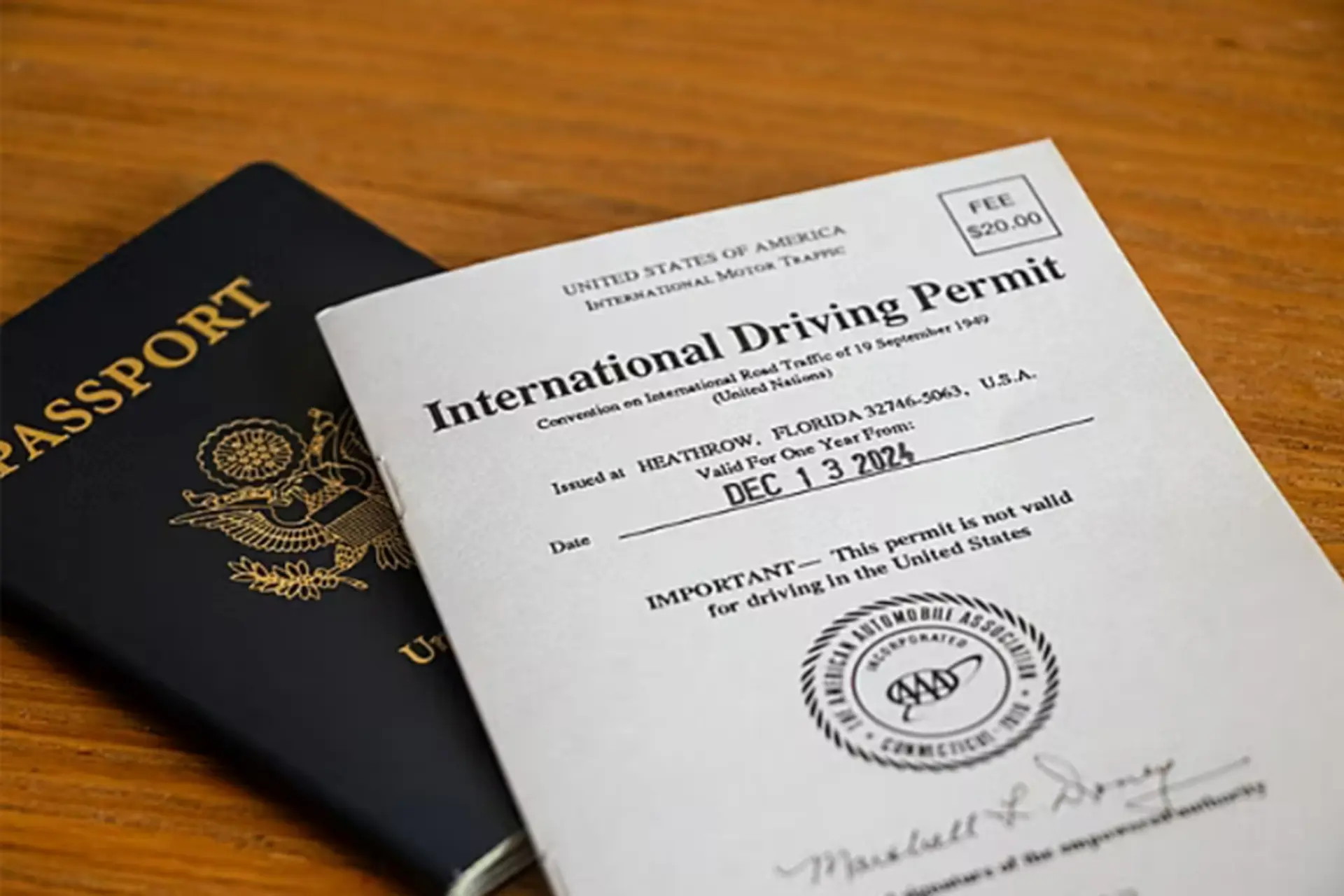
Vietnam’s Law on Road Traffic Order and Safety recognises, among other categories, a qualifying International Driving Permit issued by a country that is a party to the 1968 Vienna Convention on Road Traffic together with the corresponding national driving licence, provided the licences are appropriate for the vehicle being ridden and remain valid. word is together.
An IDP does not automatically replace your national licence.
A qualifying foreign rider using the Vienna Convention route must carry both the appropriate IDP and the corresponding national licence.
The entitlement must also cover the motorcycle category you are actually riding.
Having a car licence does not automatically authorise you to ride a motorcycle.
Motorcycle capacity matters
This deserves special attention when booking adventure tours using motorcycles such as 150 cc, 250 cc or larger machines.
Under Decree 168, riding without an appropriate licence can result in substantial fines.
For motorcycles up to 125 cc or the corresponding electric-power category, certain licensing violations can attract fines of VND 2,000,000–4,000,000.
For motorcycles over 125 cc, the relevant fine can reach VND 6,000,000–8,000,000 where the rider does not have a valid, appropriate licence or commits other specified licensing violations. higher category includes a rider holding a qualifying Vienna Convention IDP but failing to carry the corresponding appropriate national driving licence. rental shop gave me the bike” is not a licence
This misconception causes unnecessary problems.
The fact that someone is willing to rent or provide you with a motorcycle does not itself prove that you are legally entitled to ride it.
Before travelling to Vietnam, check:
👉 your national motorcycle licence category,
👉 whether your country participates in the relevant international framework,
👉 your IDP type,
👉 the expiry dates,
👉 and the engine category of the motorcycle you intend to ride.
Do this before booking flights if riding is a central part of your holiday.
Licence legality may also affect travel or motorcycle insurance coverage. Travellers should therefore confirm the policy wording directly with their insurer rather than assuming that an ordinary travel-insurance policy covers recreational motorcycling.
8. Helmets & Passenger Safety
A helmet is not a decorative part of a Vietnam motorbike photograph.
It is essential safety equipment.
Motorcycle riders and passengers are generally required to wear appropriate motorcycle helmets and fasten them correctly.
Under Decree 168, riding without a helmet, wearing one without fastening it correctly, or carrying a passenger who does not comply with the helmet requirement can attract a fine of VND 400,000–600,000, subject to limited statutory exceptions. se protection for the ride you are actually doing
A short scooter journey through a city is different from an eight-day mountain motorcycle expedition.
For adventure touring we strongly recommend quality protective equipment appropriate for the journey:
👉 a correctly fitted helmet,
👉 riding gloves,
👉 motorcycle jacket or suitable protective layer,
👉 long trousers or riding pants,
👉 and proper closed footwear or riding boots.
For off-road sections, additional protective equipment becomes even more valuable.
Passenger safety matters too
If riding with a pillion, remember that the motorcycle behaves differently.
Braking distance increases.
Low-speed balance changes.
Acceleration changes.
A passenger who is unfamiliar with motorcycles may also move unexpectedly.
Explain beforehand how to:
👉 mount and dismount,
👉 sit during corners,
👉 keep feet on the footrests,
👉 avoid sudden movement,
👉 and communicate with the rider.
A relaxed, informed passenger makes the motorcycle safer for both people.
9. Police Checks, Rider Documents & Camera-Based “Phạt Nguội”
Foreign travellers sometimes assume a police check in Vietnam will be complicated.
Usually, the best approach is the simplest:
👉 Remain calm.
👉 Stop safely.
👉 Be polite.
👉 Follow lawful instructions.
👉 Do not become confrontational.
Your tour guide can assist with language and communication where appropriate, but the rider remains responsible for his or her own conduct and legal documents.
What documents should riders have available?
Depending on the rider and vehicle arrangement, relevant documentation may include:
👉 passport or appropriate identification,
👉 valid national driving licence,
👉 qualifying International Driving Permit where applicable,
👉 motorcycle registration documentation,
👉 and evidence of compulsory motor vehicle civil-liability insurance as required.
Decree 168 also provides penalties relating to missing compulsory insurance and various licensing/document violations. Traffic Cameras and “Post-Violation” Fines in Vietnam
This part is increasingly important.
Vietnamese traffic enforcement uses camera systems and authorised technical equipment to detect violations.
Ministry of Public Security Circular 73/2024/TT-BCA regulates police patrol, control and traffic-violation handling and expressly provides for monitoring through traffic-surveillance systems, cameras, technical equipment and relevant databases. cial notification form issued under Circular 73 shows that where an offence is recorded through technical equipment, a notification can be addressed to the vehicle owner, identifying the vehicle and requiring the matter to be resolved with the competent authority. what travellers often describe as “phạt nguội”—a violation detected and processed after the rider has already passed the location.
Why this matters for motorcycle tours
Imagine a foreign guest riding motorcycle number A on Day 3.
A traffic camera records that motorcycle committing an offence.
The tour finishes five days later.
The guest flies home.
Only later does the registered vehicle owner or operator become aware of the official violation notice.
This creates an obvious operational question:
Who should ultimately be responsible for the violation?
The fairest answer is:
The rider who actually committed the violation should be responsible, once that responsibility has been properly established through official evidence.
However, tour operators should handle this transparently rather than inventing arbitrary penalties of their own.
A Fair Post-Tour Legal Responsibility System for Motorcycle Operators
For professionally organised motorcycle tours, we recommend a documented Rider Traffic Responsibility Policy.
Before the tour
Each guest should receive the traffic-safety policy before riding.
The booking or motorcycle-use agreement should explain that the rider is responsible for traffic violations personally committed while operating the assigned motorcycle, including violations officially detected after the tour by authorised traffic-camera or enforcement systems.
This clause should also explain what documentation may be shared with competent authorities where legally required.
At motorcycle handover
Record clearly:
👉 rider’s full name,
👉 passport details as necessary for the lawful contractual purpose,
👉 valid driving-licence information,
👉 motorcycle registration number,
👉 date and time of handover,
👉 date and time of return.
For tours where riders exchange motorcycles, update the riding log.
This is extremely important.
Without a reliable rider-to-motorcycle record, it may be difficult to establish fairly who was operating a particular motorcycle when a camera violation occurred.
When a delayed violation arrives
The operator should first verify that there is an official violation notice or reliable official record.
Then compare:
- registration number,
- date,
- time,
- location,
- photographic or camera evidence where available,
- and the motorcycle assignment record.
The guest should receive a copy of the relevant official information and a reasonable opportunity to raise an obvious factual error—for example, if the motorcycle had already been reassigned to another rider.
Payment responsibility
Rather than charging an arbitrary “penalty deposit,” the contract can state that a rider is responsible for the actual officially imposed fine and documented legally related administrative costs attributable to his or her violation, to the extent permitted by applicable law and the agreed contract.
The company should not profit from traffic fines.
Transparency is crucial.
Should operators hold a security deposit?
A carefully drafted refundable security deposit may be commercially useful for motorcycles, damage and unresolved legal liabilities, but its amount, retention period, deduction conditions, payment-processing rules and consumer-law implications should be reviewed by qualified Vietnamese legal counsel before implementation.
For that reason, we do not recommend simply writing:
“Your credit card will automatically be charged for any future traffic fine.”
A better policy is evidence-based, proportionate and documented.
Privacy also matters
Passport, licence and payment information are personal data.
Operators should collect only information genuinely necessary for tour operations, safety, legal compliance and contractual responsibility, store it securely and apply an appropriate retention policy.
The objective is accountability—not indefinite surveillance of guests.
10. Safe Group Riding on Vietnam Motorbike Tours
Group riding is one of the great pleasures of an organised motorcycle expedition.
You share mountain passes, roadside coffee stops, mechanical stories, muddy boots and the satisfaction of arriving at a remote destination together.
But ten individually competent riders do not automatically create a safe group.
A good group needs structure.
Never race the rider ahead
The objective is not to keep the rear tyre of the motorcycle ahead constantly in sight.
On winding roads, each rider needs enough space to:
- see hazards,
- choose a safe line,
- brake comfortably,
- and react independently.
Do not ride side by side where conditions make it unsafe
A scenic road is not a formation-riding display.
Maintain appropriate spacing and position according to the road, visibility, weather and instructions from the tour leader.
The weakest rider influences the group pace
This is not a criticism.
Different riders arrive with different backgrounds.
One guest may have twenty years of enduro experience.
Another may be completely comfortable on highways but have limited experience with mud.
Someone else may be excellent off-road but unfamiliar with Asian urban traffic.
A professional tour is not a competition.
The group’s pace and route management should allow all appropriately qualified participants to ride safely.
Where the itinerary allows, experienced riders may sometimes take a more technical section while other riders use an easier alternative route—but only where the tour operator can manage both groups safely and responsibly.
Respect local communities
Motorcycle adventure tourism should create positive memories for both visitors and residents.
- Slow down through villages.
- Avoid unnecessary revving.
- Give children, pedestrians and animals plenty of space.
- Do not treat rural roads as race tracks.
Remember that the road passing through a beautiful mountain village is not just part of your adventure.
- It may be someone’s route to school.
- Someone’s walk to the market.
- Someone’s front doorstep.
That perspective changes the way good riders behave.
Common Vietnam Motorcycle Traffic Fines at a Glance
|
The following table summarises selected motorcycle penalties discussed above under Decree 168/2024/NĐ-CP as applicable in July 2026. Circumstances can change the legal classification and consequences. c Violation |
Indicative Motorcycle Fine |
|
Speeding 5 to under 10 km/h over limit |
VND 400,000–600,000 |
|
Speeding 10–20 km/h over limit |
VND 800,000–1,000,000 |
|
Speeding more than 20 km/h over limit |
VND 6,000,000–8,000,000 |
|
Group of 2+ motorcycles speeding |
VND 8,000,000–10,000,000 |
|
Running a red light |
VND 4,000,000–6,000,000 |
|
Wrong direction on one-way/no-entry road |
VND 4,000,000–6,000,000 |
|
Motorcycle entering an expressway |
VND 4,000,000–6,000,000 |
|
Improper/no turn signal when changing direction |
VND 600,000–800,000 |
|
No helmet / improperly fastened helmet |
VND 400,000–600,000 |
|
Hand-held phone/electronic device while riding |
VND 800,000–1,000,000 |
|
Alcohol – lower statutory level |
VND 2,000,000–3,000,000 |
|
Alcohol – intermediate level |
VND 6,000,000–8,000,000 |
|
Alcohol – highest specified level |
VND 8,000,000–10,000,000 |
|
Serious licence violation, motorcycle ≤125cc |
VND 2,000,000–4,000,000 |
|
Serious licence violation, motorcycle >125cc |
VND 6,000,000–8,000,000 |
|
Specified traffic violation causing an accident |
VND 10,000,000–14,000,000 |
|
Leaving/not properly handling accident scene in specified circumstances |
VND 8,000,000–10,000,000 |
Some offences can additionally involve licence-point deductions, licence suspension or other legal consequences, depending on the violation. ive Simple Rules We Ask Every Foreign Rider to Remember
You do not need to memorise an entire Vietnamese traffic code before enjoying a motorcycle holiday.
Remember five principles.
1. Never ride after drinking alcohol.
Park first. Drink later.
2. A red light means stop.
Losing your group for thirty seconds is better than taking a dangerous risk.
3. Ride at a speed that lets you react to what you cannot yet see.
This matters especially on mountain roads.
4. Carry the correct licence documents for the motorcycle you ride.
Check this before travelling to Vietnam.
5. Respect the people who live beside the roads you came to enjoy.
Slow through villages, give way generously and keep unnecessary noise down.
Final Thoughts: The Best Vietnam Motorcycle Adventure Is the One You Finish Safely
Vietnam is one of Asia’s great motorcycle destinations.
The country rewards riders with extraordinary diversity: limestone mountains, terraced rice fields, misty passes, remote ethnic villages, tropical forests, war-history routes, coastline and some of Southeast Asia’s most memorable riding roads.
Traffic law should not take the adventure away.
It protects the adventure.
A traffic fine may cost money, but the real reason to respect the rules is much bigger.
- Every safe decision protects you.
- It protects your pillion.
- It protects the rider behind you.
And it protects the local family whose everyday road happens to be part of your holiday.
So when you finally leave the city behind and point your motorcycle toward the mountains, remember:
- You do not need to be the fastest rider on the road.
- You do not need to prove anything.
- Read the road.
- Listen to your guide.
- Respect Vietnamese traffic law.
- Give local communities the same consideration you would expect at home.
And let the journey—not the speed—become the story you remember.
Ride Vietnam. Respect Vietnam. Ride Safe. Ride Legal.