
A great motorcycle journey is never only about the motorcycle.
Years later, most riders will remember the sweeping mountain passes, the muddy trails, the roadside coffee stops, the village lunches and the moments when the road disappeared into mist.
But very often, they remember something else even more clearly:
the person who guided them through it all.
A professional motorcycle tour guide in Vietnam is rarely just the person riding at the front of the group.
- He may be the one who notices that your rear tyre is losing pressure before you do.
- He may quietly change tomorrow’s route because overnight rain has turned a mountain trail into something unsuitable for the group’s riding ability.
- He may know which family in a remote village serves the best lunch, where to find a mechanic after sunset, when a river crossing is safe, which road is temporarily closed and when an inexperienced rider needs encouragement rather than pressure.
- He translates language.
- He interprets culture.
- He reads the road.
- He manages personalities.
And, perhaps most importantly, he carries a significant part of the responsibility for getting everybody safely from one destination to the next.
That is why tipping at the end of a motorcycle tour can mean something deeper than simply giving someone additional money.
Done thoughtfully, it becomes a way of saying:
“Thank you for looking after us.”
However, international travellers come from very different tipping cultures.
An American guest may naturally expect to leave a gratuity after good service.
A British traveller may tip when service has been particularly good but dislike feeling that it is compulsory.
An Australian or New Zealander may come from a culture where tipping is generally optional and therefore feel uncomfortable when a suggested amount sounds like an obligation.
Travellers from continental Europe, Scandinavia or parts of Asia may have entirely different expectations again.
A responsible tour operator therefore needs to find the right balance: encourage appreciation without creating pressure.
This guide explains how international riders can approach tipping in Vietnam, why motorcycle guides deserve particular consideration, and how tour companies can create a fair, transparent and culturally respectful tipping policy.
Is Tipping Compulsory in Vietnam?
No.
Tipping is generally not compulsory in Vietnam.
Vietnam’s official tourism website notes that tipping is more common for tour guides and spa services than in restaurants, but visitors are under no obligation to leave a tip.
That distinction is extremely important.
A gratuity should never be presented as:
- a hidden tour charge,
- an unofficial salary supplement guests are forced to provide,
- a mandatory payment disguised as a cultural custom,
- or something that determines whether the guide treats the guests well.
The price of a professional tour should already cover the services that have been promised.
A tip belongs to a different category.
It is a voluntary expression of appreciation for good or exceptional service.
This principle should remain at the centre of every tipping policy.
Why Motorbike Guides Are Different From Ordinary Tour Guides
Motorcycle guiding is unusually demanding because it combines tourism, logistics, group management and road safety.
On a conventional sightseeing tour, the guide may explain a temple, organise hotel check-in and coordinate transportation.
A motorcycle guide often does all of this while simultaneously managing a moving group of riders across hundreds or even thousands of kilometres.
Consider what happens during a typical multi-day northern Vietnam motorcycle expedition.
At 07:30, the guide checks weather conditions.
Before departure, he may inspect motorcycles or coordinate with the mechanic.
Once everyone starts riding, he monitors the group’s pace and spacing.
At a mountain junction, he needs to ensure nobody misses the turn.
On an off-road section, he assesses whether the surface is suitable for every rider.
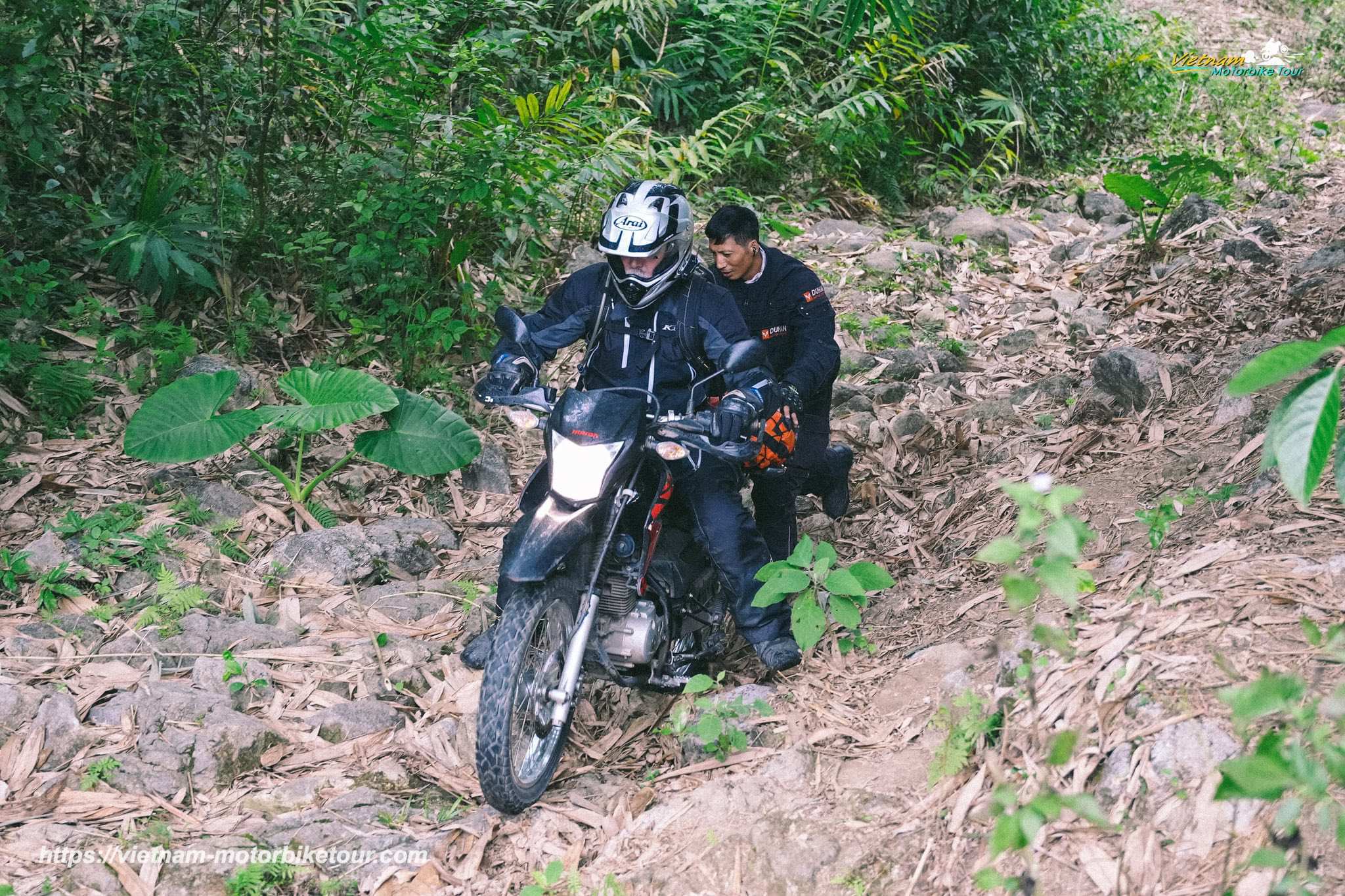
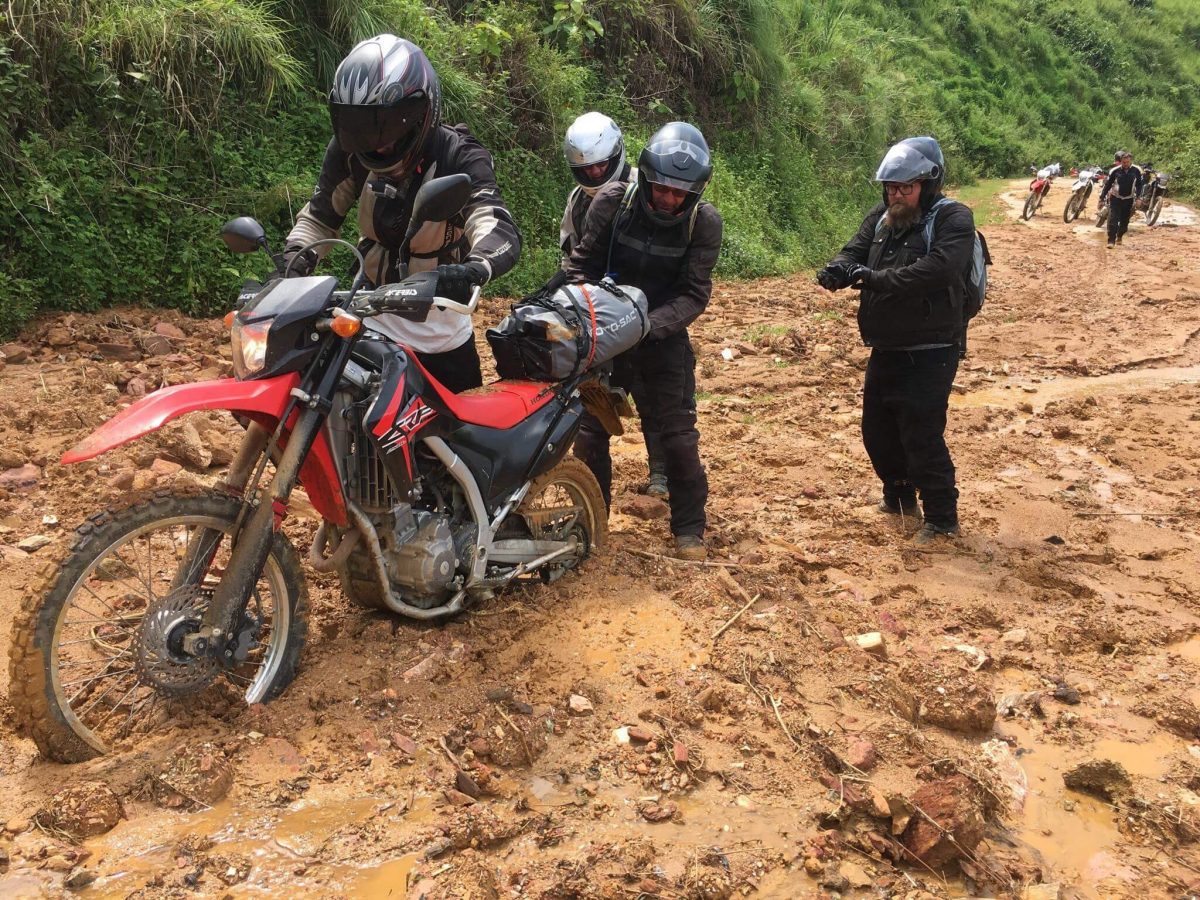
If somebody drops a motorcycle, he is usually one of the first people helping to lift it.
At lunch, he communicates dietary requirements.
During village visits, he becomes the cultural bridge between travellers and local families.
At the hotel, he coordinates rooms, meals and tomorrow’s departure.
And long after the guests begin enjoying dinner, the guide may still be checking motorcycles, speaking with the mechanic or reviewing the next day’s route.
A skilled motorcycle guide therefore contributes to at least five parts of the journey:
- Safety.
- Navigation.
- Logistics.
- Cultural interpretation.
- Human connection.
This combination is what makes the relationship between riders and guides so distinctive.
By Day 1, he may be “the guide.”
By Day 8, he is often simply part of the riding group.
A Tip Should Recognise Service, Not Replace Fair Wages
This is one of the most important ethical principles for tour operators.
Tour companies should never design staff compensation on the assumption that guests will provide tips.
Guides should receive fair contractual compensation for the work they are hired to perform.
Tipping should sit above that foundation.
The traveller is then free to reward qualities such as:
- exceptional attention,
- professionalism,
- problem-solving,
- patience,
- local knowledge,
- technical support,
- flexibility,
- warmth,
- and outstanding care.
This distinction protects everyone.
The guide does not have to emotionally “sell” for a tip.
The customer does not feel financially responsible for the guide’s basic income.
And the tour company avoids turning a genuine human gesture into an awkward commercial transaction.
Understanding International Tipping Cultures
There is no single “international tipping culture.”
That is why a motorbike tour company should avoid giving the same message to every nationality without context.
Cultural patterns can help us understand expectations, but they should never become stereotypes.
Individual travellers vary enormously.
Still, several broad tendencies are useful.
Riders From the United States and Canada
North American travellers are generally more familiar with tipping as part of the service economy.
For many Americans in particular, giving gratuities to restaurant servers, drivers and service staff is normal behaviour.
Because tipping is familiar, a straightforward suggested range usually causes relatively little discomfort.
American guests may actually appreciate clear guidance because their question is often:
“What is considered appropriate here?”
Rather than:
“Why am I expected to tip?”
For this market, a tour operator can be relatively direct:
“Tipping is optional in Vietnam, but if you feel your guide has taken especially good care of you, a gratuity at the end of the tour is always appreciated.”
A suggested guideline can then be offered without making it mandatory.
The key is still to use language such as:
“suggested,” “optional,” “at your discretion,” and “based on your satisfaction.”
Riders From the United Kingdom and Ireland
British travellers are generally familiar with tipping but often distinguish strongly between appropriate gratuity and automatic expectation.
VisitBritain itself explains that tipping in Britain is not expected in the same way as in some other countries; it is optional but appreciated after good service.
This helps explain why some British travellers react negatively when a gratuity is presented too aggressively.
They usually do not object to tipping.
They object to feeling that a voluntary gesture has quietly become compulsory.
For British riders, the best communication style is understated.
For example:
“There is no compulsory tipping on our tours. At the end of the trip, some guests choose to give the guide and support team a gratuity if they feel the service has been excellent. This is entirely at your discretion.”
That sentence respects both cultures.
Riders From Australia
Australia has a noticeably different tipping culture.
Tourism Australia states clearly that tipping is a matter of choice and is generally not expected, although guests may tip for good service.
That means Australian riders may interpret a heavily promoted tipping guideline differently from an American guest.
An amount presented too strongly can feel like an additional compulsory tour charge.
For Australian travellers, we recommend emphasising appreciation rather than expectation:
“Tipping isn’t required. Some riders like to thank their guide personally at the end of a great trip, but there is absolutely no obligation.”
Then, only when the customer asks for guidance, provide the suggested amount.
This approach feels natural and avoids creating unnecessary resistance.
Riders From New Zealand
New Zealand is similarly relaxed about gratuities.
Tourism New Zealand explicitly states that tipping is not obligatory, although visitors may choose to tip for good service or kindness.
Interestingly, New Zealand culture also contains the concept of koha—an offering or gift expressing thanks in particular cultural contexts. Tourism New Zealand describes koha in Māori welcoming ceremonies as an offering symbolising thanks for hospitality.
We should not equate a commercial tour tip with a traditional Māori koha.
But there is a useful human parallel:
gratitude does not have to feel transactional.
For Kiwi riders, tipping communication works best when it feels like a personal thank-you rather than a service fee.
Riders From Continental Europe
Europe cannot be treated as one tipping market.
German, French, Dutch, Belgian, Italian, Spanish, Czech, Swiss and Scandinavian travellers all bring different habits.
Nevertheless, many European travellers come from environments where hospitality workers are expected to receive their normal wage from their employer and tipping functions mainly as recognition for good service.
Consequently, some European customers may react poorly to phrases such as:
“You should tip…”
or:
“The expected tip is…”
A more culturally neutral phrase is:
“Tipping is not compulsory in Vietnam. However, if you are happy with the care provided by your guide and riding team, you are welcome to leave a gratuity as a personal thank-you.”
With European customers, transparency matters particularly strongly.
They usually respond better when the tour price, inclusions, exclusions and voluntary gratuities are clearly separated.
Riders From Nordic Countries
Travellers from Norway, Sweden, Denmark and Finland often come from societies where tipping is much less central to service transactions.
For these guests, the emotional message matters more than the financial instruction.
Do not frame tipping as:
“This is what tourists are expected to pay.”
Instead frame it as:
“This is one optional way riders sometimes show their appreciation after a particularly good trip.”
A Scandinavian guest may prefer:
a modest tip,
buying the guide dinner,
sharing photographs,
writing an excellent review,
or sending a personal thank-you message.
All are legitimate expressions of appreciation.
Riders From Asian Markets
Asian markets are equally diverse.
Travellers from Japan, South Korea, Singapore, Taiwan, India and other parts of Asia should not be treated as a single cultural group.
Some come from cultures where service staff rarely receive gratuities.
Others are increasingly accustomed to tipping in international tourism.
The safest principle remains:
explain the local context, never assume prior knowledge, and never pressure the guest.
So How Much Should You Tip a Motorbike Tour Guide in Vietnam?
There is no legally required amount.
There is also no universal figure that is correct for every tour.
A fair guideline should consider:
- length of the trip,
- group size,
- complexity of the route,
- guide responsibilities,
- presence of mechanic/support crew,
- level of service,
- and the guest’s satisfaction.
For international motorcycle tours, one practical voluntary framework could be:
Standard good service
USD 5–10 per rider per day for the lead guide
Very good or exceptional service
USD 10–15+ per rider per day
For mechanics, support riders and drivers, a lower separate amount or a shared team gratuity may be appropriate depending on their involvement.
These figures should always be presented as guidance rather than obligation.
For example, on an eight-day motorcycle journey:
- A rider who feels the guide provided excellent service might choose a gratuity somewhere around USD 40–80.
- A guest who believes the guide went far beyond normal expectations may choose more.
- Another guest may choose less.
- And a guest remains free not to tip.
That freedom is what keeps the gesture meaningful.
Individual Tipping or Group Tipping?
Both approaches can work.
Individual tipping
Each traveller gives whatever amount feels appropriate.
This is personal and straightforward.
It works particularly well for private tours and small groups.
Group tipping
The group collects a shared gratuity and presents it together.
This can work beautifully on longer motorcycle expeditions.
Imagine the final evening.
Eight riders have travelled together for ten days.
There have been river crossings, rainstorms, broken levers, mountain sunsets and countless roadside coffees.
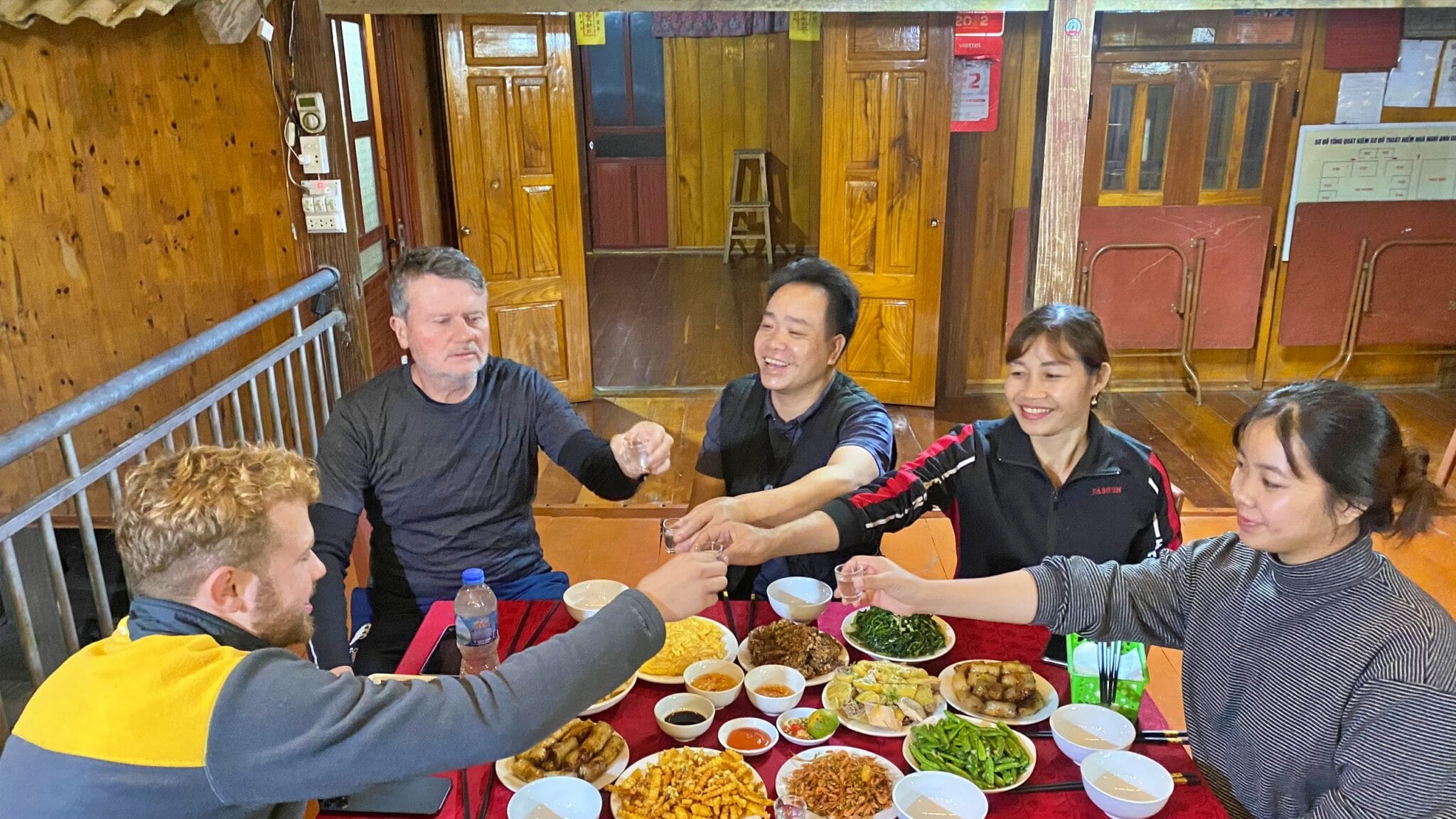
At dinner, one rider says a few words on behalf of the group and hands the guide an envelope.
The amount matters.
But often the words matter more.
“Thank you for getting us through the mountains safely and for showing us a Vietnam we would never have discovered alone.”
That moment transforms money into recognition.
Cash, Envelope or Digital Transfer?
Cash remains one of the simplest ways to give a gratuity in Vietnam.
Vietnam Tourism notes that cash remains commonly used for small transactions, although cards and electronic payments are increasingly widespread.
For tour gratuities, several approaches work well.
Cash directly to the guide
Simple and personal.
Cash in an envelope
Particularly appropriate after a long tour.
It creates a little privacy and avoids making the amount part of a public discussion.
Group envelope
Excellent for larger riding groups.
Digital transfer
Can be practical if the guide has an appropriate payment option.
However, operators should not force guests into complicated transfer arrangements simply for tipping.
The easier the process feels, the more natural the gesture remains.
When Is the Best Time to Give the Tip?
Usually at the end of the tour.
This avoids any suggestion that the guest is tipping in advance to obtain better treatment.
For a multi-day motorcycle trip, the natural moment might be:
after returning the motorcycles,
during the farewell dinner,
after the final hotel check-in,
or immediately before the group says goodbye.
The guide has completed the work.
The traveller has experienced the full service.
Both sides understand what the gratuity represents.
The Tour Leader Should Never Ask for His Own Tip
This is a rule we strongly recommend.
A guide saying:
“Tomorrow is the last day, so please prepare my tip.”
can destroy several days of excellent service in one sentence.
It changes the relationship.
What previously felt like hospitality suddenly feels transactional.
Tipping information should therefore come from:
the company’s website,
pre-departure information,
booking confirmation,
tour notes,
or customer-service staff.
Not from the guide requesting money personally.
The guide’s responsibility is simple:
deliver excellent service.
The company handles expectations.
The guest makes the decision.
How a Tour Company Should Introduce Tipping
Timing matters enormously.
We recommend mentioning gratuities at three carefully selected points.
1. On the Website or Tour FAQ
Keep it brief.
Is tipping compulsory?
No. Tipping is completely voluntary in Vietnam. However, guests who feel their guide and riding team provided exceptional service are welcome to leave a gratuity at the end of the tour.
This immediately removes uncertainty.
2. In the Pre-Tour Information
Provide slightly more detail.
Tipping & Appreciation
Tipping is not included in your tour cost and is never compulsory. If, at the end of your journey, you feel your guide or support team has taken particularly good care of you, a gratuity is always warmly appreciated. As a general reference, some international riders choose approximately USD 5–10 per rider per day for a guide, with the final amount entirely dependent on your satisfaction and personal preference.
This gives customers a useful benchmark without turning it into a bill.
3. At the End of the Trip
Do not send:
“Reminder: please tip your guide tomorrow.”
That feels commercial.
A better farewell message is:
“Tomorrow is the final riding day. We hope you’ve had a wonderful journey with the team. As mentioned in your pre-tour information, gratuities are entirely optional. The most important thing for us is that you’ve felt safe, well cared for and genuinely connected with the places you’ve visited.”
No amount needs to be repeated.
The customer already knows.
Reward the Whole Team, Not Only the Person in Front
One potential weakness of tipping systems is that the most visible person receives everything.
On a motorcycle tour, other team members may work just as hard.
There might be:
- a mechanic,
- support rider,
- 4WD support driver,
- luggage driver,
- assistant guide,
- or local guide.
A fair company should explain the structure.
For example:
“You are welcome to tip individual team members directly, or, if you prefer, give one gratuity to the tour leader and ask that it be shared among the team.”
However, if the company offers pooled tipping, guests should know how it is distributed.
Transparency prevents mistrust.
Never Compare One Guest’s Tip With Another
This is essential.
A guide should never say:
“The previous group gave me $100 each.”
or:
“American guests normally give more.”
or:
“Your group gave less than last week’s group.”
These comments are inappropriate.
They turn culture into leverage.
They also damage the genuine hospitality relationship that makes motorcycle touring special.
Every guest’s financial situation, cultural background and perception of service is different.
A tip is personal.
Keep it personal.
A Positive Review Can Also Be Incredibly Valuable
Money is not the only way travellers can thank a good guide.
An excellent review mentioning the guide by name can have enormous professional value.
A traveller might write:
“Our guide made the entire journey. He understood our riding level, changed the route after heavy rain, introduced us to wonderful local families and made us feel safe throughout the trip.”
That review may help future guests choose the company.
It may also help that guide build his professional reputation.
Other meaningful gestures include:
- sharing photographs,
- sending a personal thank-you,
- recommending the company to riding friends,
- requesting the same guide on a future trip,
- or keeping in touch after returning home.
Sometimes the most meaningful sentence a guide can hear is simply:
“You didn’t just show us Vietnam. You helped us understand it.”
When a Tip Should Not Be Expected
A gratuity should reflect satisfaction.
If a customer experienced:
- serious unprofessional behaviour,
- unsafe guiding,
- consistent lateness,
- poor communication,
- avoidable negligence,
- or disrespect,
- the traveller should feel no obligation to leave a gratuity simply because a guideline exists.
The better solution is honest feedback.
Tour operators should make this clear.
That protects the integrity of tipping.
When staff know gratuities represent genuine recognition rather than entitlement, the system encourages better service.
Tipping Should Encourage Hospitality, Not Performance Theatre
There is another danger worth discussing.
When guides become too focused on earning gratuities, service can become theatrical.
The guide may start prioritising:
- entertaining the biggest tipper,
- excessive personal attention,
- constant jokes,
- unnecessary free drinks,
- or activities designed to please rather than protect the group.
That is not the culture a professional motorcycle operator should build.
The guide’s priorities should remain:
- Safety first.
- Professional service second.
- Authentic hospitality always.
The tip follows naturally.
A Recommended Tipping Policy for Professional Motorbike Tour Operators
A strong policy can be built around six principles.
1. Voluntary
Tipping is always optional.
2. Transparent
Suggested guidelines are disclosed before the tour.
3. No guide solicitation
Guides should never ask clients directly for gratuities.
4. Performance-based
Guests decide according to service quality and satisfaction.
5. Culturally sensitive
Communication is adapted to travellers from different tipping backgrounds.
6. Fair to the team
Mechanics, drivers and assistants should not be forgotten simply because they are less visible.
Suggested Website Tipping Policy
A tour operator could publish the following:
Tipping & Gratuities
Tipping is not compulsory in Vietnam and is not included as a mandatory part of our tour price.
However, motorcycle touring is a highly personal form of travel, and many guests choose to thank their guide or support team at the end of the journey when they feel they have received excellent care and service.
For travellers who would like a general reference, a gratuity of approximately USD 5–10 per rider per day for the lead motorcycle guide is commonly considered a thoughtful gesture for good service, with higher amounts sometimes given for exceptional service. Mechanics, support riders and drivers may also be tipped separately or through a shared team gratuity.
These amounts are suggestions only.
The decision whether to tip—and how much—is entirely yours.
We believe gratuities should always reflect genuine appreciation rather than obligation.
What Makes a Guide Truly Worth Tipping?
The best guides are rarely the ones talking the most.
Often they are the ones quietly noticing everything.
A great motorcycle guide:
- checks that everybody has started their bike before leaving,
- waits after difficult corners,
- adjusts the route according to weather,
- never humiliates an inexperienced rider,
- doesn’t encourage reckless riding,
- finds solutions when motorcycles break,
- remembers dietary requirements,
- introduces guests respectfully to local communities,
- explains history without turning it into a lecture,
- and somehow keeps smiling after ten hours on the road.
- He knows when to lead.
- He knows when to wait.
And he understands that riders have travelled halfway around the world not simply to follow a GPS track, but to experience something meaningful.
That is difficult to place a price on.
Which is exactly why a gratuity should never feel like a price.
The Human Meaning Behind a Tip
Responsible tourism is ultimately about relationships.
Vietnam Tourism encourages travellers to support communities, local enterprises and responsible tourism experiences that create positive connections between visitors and local people.
Tipping, when handled respectfully, can be part of that philosophy.
Imagine the final morning of a twelve-day ride.
The motorcycles are dusty.
Boots are dirty.
Everyone is tired.
During the trip there may have been rain in Ha Giang, fog over a mountain pass, an unexpected puncture somewhere far from town and perhaps one rider who nearly lost confidence after a difficult trail.
But everyone made it.
Now the guide is helping load the final luggage.
A rider walks over, shakes his hand and gives him an envelope.
Nothing dramatic happens.
No ceremony is necessary.
Perhaps just four words:
“Thanks for looking after us.”
For the traveller, it may be a relatively small part of the total cost of an international holiday.
For the guide, however, it carries another message:
Your effort was noticed.
Your professionalism mattered.
The journey was better because you were part of it.
That recognition can be every bit as important as the money itself.
Final Thoughts: Gratitude Should Never Feel Compulsory
There is no perfect tipping formula that fits every traveller.
An American rider and an Australian rider may approach gratuities differently.
A British couple and a Norwegian group may have different expectations.
A first-time traveller may feel uncertain.
An experienced international rider may already have his own practice.
All of those perspectives deserve respect.
The goal of a professional tour operator should therefore never be to maximise gratuities.
The goal should be to create service worthy of appreciation.
Tell travellers clearly that tipping is optional.
Give guidance when they need it.
Never embarrass them.
Never compare nationalities.
Never allow guides to demand gratuities.
Pay staff fairly.
And let excellent service create its own reward.
Because at the end of a memorable motorcycle journey, tipping should not feel like settling one final bill.
It should feel like what it was always meant to be:
a personal thank-you from one human being to another.
And sometimes, after hundreds of kilometres of shared roads, rain, mountains, laughter and adventure, that simple thank-you carries a story of its own.